Garmin Index™ BPM, Smart Blood Pressure Monitor Review 2026
Your blood pressure tells a story about your heart health every single day. But most people ignore it until a doctor raises a red flag.
The Garmin Index™ BPM Smart Blood Pressure Monitor aims to change that. It brings clinical-grade blood pressure tracking right into your home and connects it to the Garmin ecosystem you already know and love.
This FDA-cleared device does more than just show numbers on a screen. It syncs your systolic, diastolic, and heart rate data straight to Garmin Connect. You can see your blood pressure trends alongside your sleep, activity, and fitness metrics. That kind of all-in-one health picture is hard to find anywhere else.
Key Takeaways:
- FDA-cleared and clinically validated, the Garmin Index BPM delivers blood pressure accuracy within +/- 3 mmHg or 2% of the readout value. Heart rate accuracy sits within +/- 5% of the readout value. These numbers meet medical standards for home blood pressure monitors.
- Seamless Garmin Connect integration sets this device apart from most competitors. Every reading automatically syncs via Wi-Fi or Bluetooth to your Garmin Connect app. You can view blood pressure trends right alongside your fitness data, sleep stats, and weight from the Garmin Index scale.
- The all-in-one cuff design makes it compact and portable. The monitor weighs just 340 grams and fits into a small travel bag. However, some users find the stiff cuff material harder to wrap and secure compared to traditional blood pressure monitors.
- Battery life lasts up to 9 months on four AAA batteries. There is no rechargeable battery built in. This is convenient for low-maintenance use but feels like a missed opportunity in a modern smart device.
- Multi-user support allows up to 16 profiles on a single device. Each profile syncs to its own Garmin Connect account. This makes it ideal for families or couples who want to share one monitor without mixing up their health data.
- The adjustable cuff fits arm sizes from 22 cm to 42 cm (about 9 to 17 inches). This covers a wide range of adult arm sizes. The built-in OLED display shows your results immediately after each reading.

- FDA-cleared and clinically validated upper-arm blood pressure monitor delivers accurate systolic and...
- Compact, all-in-one device features an integrated display to view readings and can be taken anywhere

Last update on 2026-08-03 / Affiliate links / Images from Amazon Product Advertising API Some of the links on this website are affiliate links, which means that at no additional cost to you, I earn a commission if you click through and make a purchase. I only recommend products and services that I believe will add value to my readers. Thank you for your support!
Garmin Index™ BPM Smart Blood Pressure Monitor Overview
The Garmin Index™ BPM is an upper-arm blood pressure monitor built for people who want smarter health tracking at home. Garmin released this device as part of its Index health product line, which also includes the Index S2 smart scale. The goal is simple. Give users a complete health picture inside one app.
This monitor measures systolic blood pressure, diastolic blood pressure, and heart rate with each reading. It uses an oscillometric method, which is the same technology found in most clinical-grade home monitors. The device earned FDA clearance as a Class II medical device. Garmin also published clinical validation data on its website.
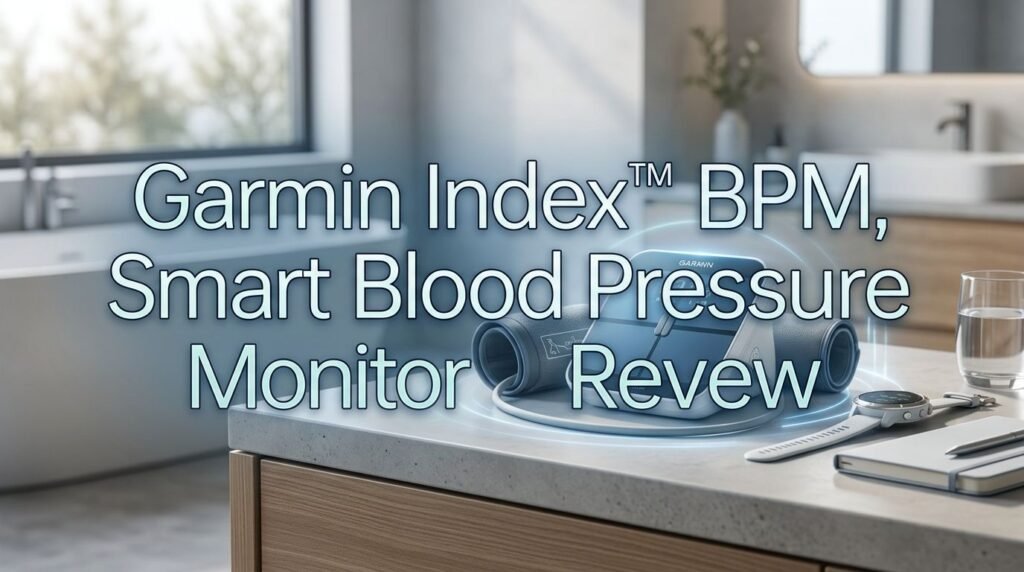
The compact form factor is one of its standout physical traits. Unlike traditional monitors with a separate pump box and hose, the Garmin Index BPM houses everything inside the cuff unit. The OLED display sits right on top of the cuff. You press one button, wait about 30 seconds, and see your numbers.
Wi-Fi and Bluetooth connectivity round out the smart features. Readings upload to Garmin Connect automatically. You never need to write down your numbers or manually log them. For anyone already using a Garmin watch or fitness tracker, this device fits right into the existing ecosystem.
Design and Build Quality
The Garmin Index BPM has a clean and modern look. The entire device is a single unit. The inflatable cuff wraps around your arm, and the monitor module sits on the outer side near your bicep. It is mostly black with a subtle Garmin logo.
Build quality feels solid. The plastic housing around the display and pump mechanism is sturdy. It does not feel cheap or flimsy. The cuff material is a bit stiff compared to some competitors. This rigidity helps the unit hold its shape for storage and travel. But it also makes wrapping the cuff around your arm a little tricky the first few times.
The device measures roughly 8 x 8 x 15 cm and weighs 340 grams. That is noticeably smaller and lighter than older-style monitors with separate pump units. You can toss it into a bag or store it in a drawer without taking up much space.
One design choice worth noting is the battery compartment on the underside. It uses four AAA batteries instead of a built-in rechargeable cell. Some users appreciate the simplicity. Others wish Garmin had gone with USB-C charging. Either way, battery life is generous at up to 9 months of use.
How to Set Up the Garmin Index BPM
Setting up the Garmin Index BPM takes just a few minutes. You start by downloading the Garmin Connect app on your iOS or Android smartphone. Open the app and go to the “Garmin Devices” section. Select “Add Device” and choose the Index BPM from the list.
Next, insert the four AAA batteries into the compartment on the back of the monitor. The OLED screen will light up and enter pairing mode. Follow the on-screen prompts in the Garmin Connect app to connect via Bluetooth. You can also set up Wi-Fi during this step so the device can sync readings even without your phone nearby.
The app walks you through entering your profile information. This includes your name, age, and arm preference (left or right). You can also set custom blood pressure targets, such as a control range your doctor has recommended. This data helps the app categorize your readings over time.
Once paired, the device is ready to go. Press the single button on the monitor, and it takes a reading. Results appear on the built-in OLED screen within about 30 seconds. They also sync to Garmin Connect almost instantly. The entire setup process is smooth and user-friendly.
Top 3 Alternatives for Garmin Index BPM
If you want to explore other smart blood pressure monitors before making a final decision, here are three strong alternatives worth checking out.

- CONFIDENCE IN EVERY READING: Monitor your heart health with the OMRON Evolv Upper Arm Blood Pressure...
- SAFEGUARD YOUR HEART: Detect heartbeat irregularities during routine blood pressure measurements...
Last update on 2026-08-03 / Affiliate links / Images from Amazon Product Advertising API Some of the links on this website are affiliate links, which means that at no additional cost to you, I earn a commission if you click through and make a purchase. I only recommend products and services that I believe will add value to my readers. Thank you for your support!

- QUICK & EAST TO READ RESULTS with color-coded feedback on display case - this blood pressure cuff...
- ONE OF THE MOST ACCURATE BLOOD PRESSURE MONITORS - FDA cleared portable automatic blood pressure...
Last update on 2026-08-03 / Affiliate links / Images from Amazon Product Advertising API Some of the links on this website are affiliate links, which means that at no additional cost to you, I earn a commission if you click through and make a purchase. I only recommend products and services that I believe will add value to my readers. Thank you for your support!

- CONFIDENCE IN EVERY READING: Monitor your heart health with the OMRON Platinum Upper Arm Blood...
- SAFEGUARD YOUR HEART: Screen for unusual heart rhythms every time you check your blood pressure with...
Last update on 2026-07-25 / Affiliate links / Images from Amazon Product Advertising API Some of the links on this website are affiliate links, which means that at no additional cost to you, I earn a commission if you click through and make a purchase. I only recommend products and services that I believe will add value to my readers. Thank you for your support!
The OMRON Evolv is a popular tubeless, wireless blood pressure monitor with Bluetooth connectivity. It stores up to 100 readings and syncs with the OMRON Connect app. It is a great pick if you do not use the Garmin ecosystem.
The Withings BPM Connect offers Wi-Fi and Bluetooth sync with the Withings Health Mate app. It has a sleek design, FDA clearance, and color-coded results on a built-in LED display. It also works with Apple Health.
The OMRON Platinum is a top-tier monitor with AFib detection, Bluetooth, and storage for 200 readings across two users. It is the number one doctor-recommended brand and offers a more traditional cuff design for easier fitting.
Blood Pressure Accuracy and Clinical Validation
Accuracy is the most important factor for any blood pressure monitor. The Garmin Index BPM has been clinically validated and carries FDA clearance as a Class II medical device. Garmin publishes its validation data openly on its website.
The official accuracy specs are +/- 3 mmHg or 2% of the readout value for blood pressure. For pulse rate, accuracy is +/- 5% of the readout value. These numbers are in line with the standards set by the Association for the Advancement of Medical Instrumentation (AAMI).
Independent reviewers have compared the Index BPM to verified monitors like the OMRON series. In side-by-side testing, readings consistently fell within 2 mmHg for both systolic and diastolic values. Heart rate matched within one beat per minute. These results show strong reliability.
Proper cuff placement is critical for accuracy. If the cuff is too loose, readings tend to skew low by 20 mmHg or more. The device does not always warn you about a bad fit. So you need to make sure the cuff is snug and positioned correctly on your upper arm each time.
Garmin Connect Integration and Data Tracking
The Garmin Connect integration is the biggest reason to choose this monitor over a basic one. Every reading syncs automatically to your Garmin Connect account. You see your blood pressure numbers alongside your heart rate, sleep, steps, weight, and workout data.
Inside Garmin Connect, you can view your blood pressure trends over days, weeks, and months. The app displays your systolic and diastolic values on easy-to-read graphs. You can also set custom control targets. The app will flag readings that fall outside your desired range.
This integration is especially useful for people who already wear a Garmin smartwatch or fitness tracker. All your health data lives in one place. You do not need to switch between multiple apps to get a full picture of your wellness.
Wi-Fi syncing is a nice bonus. The device uploads readings to the cloud even if your phone is not nearby. This means you can take your morning reading and check the results later in the app at your convenience.
Cuff Comfort and Fit
The Garmin Index BPM cuff fits arm circumferences from 22 cm to 42 cm. That covers most adult arm sizes. The adjustable Velcro closure lets you tighten or loosen the cuff to your preference.
However, the cuff material is stiffer than what you find on traditional monitors. This makes it slightly harder to wrap around your arm and secure with one hand. The Velcro panels are not continuous. They appear in sections, so you need to be precise with your placement.
Some users with very thin or very muscular arms have reported difficulty getting a snug fit. A loose cuff leads to inaccurate readings. Garmin recommends adjusting the cuff before putting it on your arm. This helps you get a tighter seal more easily.
Once the cuff is properly positioned, it feels comfortable during the measurement. The inflation and deflation cycle takes about 30 seconds. There is mild pressure on your arm, but it is no different from any other upper-arm blood pressure monitor. Overall, the cuff works well once you learn the technique.
Battery Life and Power
The Garmin Index BPM runs on four AAA batteries. Garmin claims up to 9 months of battery life, though the actual duration depends on how often you take readings and whether Wi-Fi is active.
Most users report getting several months of consistent use before needing to swap batteries. If you take one or two readings per day, you should comfortably hit the 6 to 9 month range. The OLED display shows a battery indicator so you know when power is running low.
The decision to use disposable batteries instead of a rechargeable cell is a point of debate. On one hand, AAA batteries are cheap and available everywhere. You never have to worry about a dead rechargeable battery at a critical moment. On the other hand, a USB-C rechargeable design would feel more modern and reduce waste.
There is no AC adapter or charging cable included. You get the monitor, the four AAA batteries, and a quick-start guide. This keeps the package simple and the device ready to use right out of the box.
Multi-User Support and Sharing
One standout feature of the Garmin Index BPM is its support for up to 16 user profiles. Each user connects the device to their own Garmin Connect account. This keeps all readings separate and private.
This is a major advantage for families or couples who want to share a single monitor. You do not need to buy two devices. Each person selects their profile on the monitor before taking a reading. The data then routes to the correct Garmin Connect account automatically.
Setting up additional users is easy. Each person pairs the device through their own Garmin Connect app. The monitor recognizes different accounts and labels each reading accordingly. There is no risk of mixing up data between users.
Compared to many competitors, this level of multi-user support is generous. Most blood pressure monitors support only one or two users. The Garmin Index BPM gives you 16 slots, which is more than enough for a household and even suitable for small clinical settings.
Display and Readability
The Garmin Index BPM uses a monochrome OLED display mounted directly on the cuff housing. The screen shows your systolic pressure, diastolic pressure, and heart rate immediately after each reading.
The display is bright and clear. Numbers are large enough to read without squinting. The OLED technology provides sharp contrast, making the screen easy to view in both dim and well-lit rooms. There is no backlight button to press. The screen activates automatically during and after each measurement.
You also see a date and time stamp for each reading on the display. This helps you keep track even if you do not check the app right away. A small battery icon shows remaining power at a glance.
The display does not show color-coded results or trend graphs like some competitors. All detailed analysis happens inside Garmin Connect. The on-device screen is meant for quick reference only. For most users, this is perfectly fine. You take a reading, see your numbers, and check the app later for trends.
Who Should Buy the Garmin Index BPM?
The Garmin Index BPM is a strong fit for existing Garmin users who want blood pressure data inside their Garmin Connect dashboard. If you already track your workouts, sleep, and weight with Garmin devices, this monitor completes the picture.
It is also a smart choice for anyone who values automatic data syncing. Many people forget to log their readings manually. The wireless sync removes that friction. You just press a button and the data is saved and organized for you.
People with a family history of hypertension or heart disease will benefit from regular tracking. The Garmin Index BPM makes it easy to build a long-term record of your blood pressure. You can share this data with your doctor during checkups.
However, if you are on a tight budget, a basic FDA-cleared monitor costing $30 to $50 will give you accurate readings too. The Garmin premium comes from its smart connectivity and ecosystem integration. If those features do not matter to you, there are cheaper options that work just as well for basic monitoring.
Garmin Index BPM vs. Other Smart Monitors
- FDA-cleared and clinically validated upper-arm blood pressure monitor delivers accurate systolic and...
- Compact, all-in-one device features an integrated display to view readings and can be taken anywhere
Last update on 2026-08-03 / Affiliate links / Images from Amazon Product Advertising API Some of the links on this website are affiliate links, which means that at no additional cost to you, I earn a commission if you click through and make a purchase. I only recommend products and services that I believe will add value to my readers. Thank you for your support!
The Garmin Index BPM competes directly with the Withings BPM Connect and the OMRON Evolv. All three are compact, wireless, and FDA-cleared. But each has different strengths.
The Withings BPM Connect syncs with Apple Health and the Withings Health Mate app. It has a color LED matrix display that shows results with a green, orange, or red indicator. It is a great option for Apple ecosystem users. Price is similar to the Garmin.
The OMRON Evolv offers a tubeless, one-piece design much like the Garmin. It stores up to 100 readings and syncs via Bluetooth to the OMRON Connect app. It is often priced lower than the Garmin and comes from the most trusted name in home blood pressure monitoring.
The Garmin Index BPM wins on ecosystem integration. If you already use Garmin Connect for fitness tracking, no other monitor matches the seamless data flow. But if you use Apple Health or prefer OMRON’s reputation, those alternatives are equally capable for pure blood pressure tracking.
Pros and Cons of the Garmin Index BPM
The pros are clear. FDA-cleared accuracy, automatic Wi-Fi and Bluetooth syncing, Garmin Connect integration, up to 16 user profiles, and a compact portable design all make this a premium monitor. The 9-month battery life is also a big plus for low-maintenance use.
The cons deserve attention too. The cuff material is stiff and can be hard to secure, especially for first-time users. The monitor does not always alert you to a poor fit. Price is higher than most home blood pressure monitors. And the lack of a rechargeable battery feels outdated for a smart device in 2026.
Some users on forums and review sites have reported occasional inconsistent readings. In most cases, these were traced back to improper cuff placement. Once the cuff is snug and positioned correctly, the readings are consistent and accurate.
Value is subjective here. If you see the Garmin Connect integration as essential, the premium price makes sense. If you just need a simple and accurate blood pressure monitor, you can find reliable options at a third of the cost.
Final Verdict: Should You Buy the Garmin Index BPM in 2026?
The Garmin Index BPM is one of the best smart blood pressure monitors available right now. It delivers clinically validated accuracy, seamless data syncing, and deep integration with the Garmin Connect platform. For Garmin users, it is the obvious choice.
The compact design and multi-user support add real convenience. The long battery life means you rarely think about maintenance. And the ability to view blood pressure trends alongside fitness, sleep, and weight data gives you a health overview that most standalone monitors simply cannot offer.
The cuff design has a learning curve. The price is premium. But if you want a blood pressure monitor that fits into a broader health tracking system, the Garmin Index BPM delivers on that promise. It is a worthwhile investment for anyone serious about long-term heart health monitoring.
Frequently Asked Questions
Is the Garmin Index BPM FDA cleared?
Yes. The Garmin Index BPM is an FDA-cleared Class II medical device. It has been clinically validated for accuracy. Garmin publishes the validation data on its official website. This clearance means the device meets the safety and effectiveness standards required for home blood pressure monitors sold in the United States.
How accurate is the Garmin Index BPM?
The Garmin Index BPM has an accuracy of +/- 3 mmHg or 2% of the readout value for blood pressure. Pulse rate accuracy is within +/- 5% of the readout value. These figures meet the AAMI standards for home blood pressure monitors. Real-world testing by reviewers confirms consistent readings when the cuff is properly fitted.
Can multiple people use the same Garmin Index BPM?
Yes. The Garmin Index BPM supports up to 16 individual user profiles. Each user pairs the device with their own Garmin Connect account. Readings are automatically sorted and sent to the correct account. This makes it ideal for families or shared living situations.
Does the Garmin Index BPM work without a smartphone?
Yes. You can take a blood pressure reading and view the results directly on the built-in OLED display without a phone. However, you will need the Garmin Connect app on a smartphone for initial setup, data syncing, and trend tracking over time. Wi-Fi syncing also allows data uploads without your phone being nearby.
What size arms does the Garmin Index BPM cuff fit?
The adjustable cuff fits arm circumferences from 22 cm to 42 cm (approximately 9 to 17 inches). This range covers most adult arm sizes. A proper fit is essential for accurate readings. Garmin recommends adjusting the cuff before placing it on your arm for the best results.
Is the Garmin Index BPM worth the price?
The Garmin Index BPM costs more than basic home blood pressure monitors. Its value lies in Garmin Connect integration, wireless syncing, multi-user support, and a compact portable design. If you already use Garmin products and want all your health data in one place, the investment makes sense. If you only need basic blood pressure readings, a more affordable monitor will serve you well.

Hi, I’m Elowen Porter, the creator of GreenLight.blog.
I share honest reviews and insights on supplements and Amazon health products to help you make smarter wellness choices.
With a passion for natural living and evidence-based products, I dig deep to find what truly works.
My goal is to simplify your supplement search with real results and trusted recommendations.
Let’s make healthy living a little easier—one product at a time.