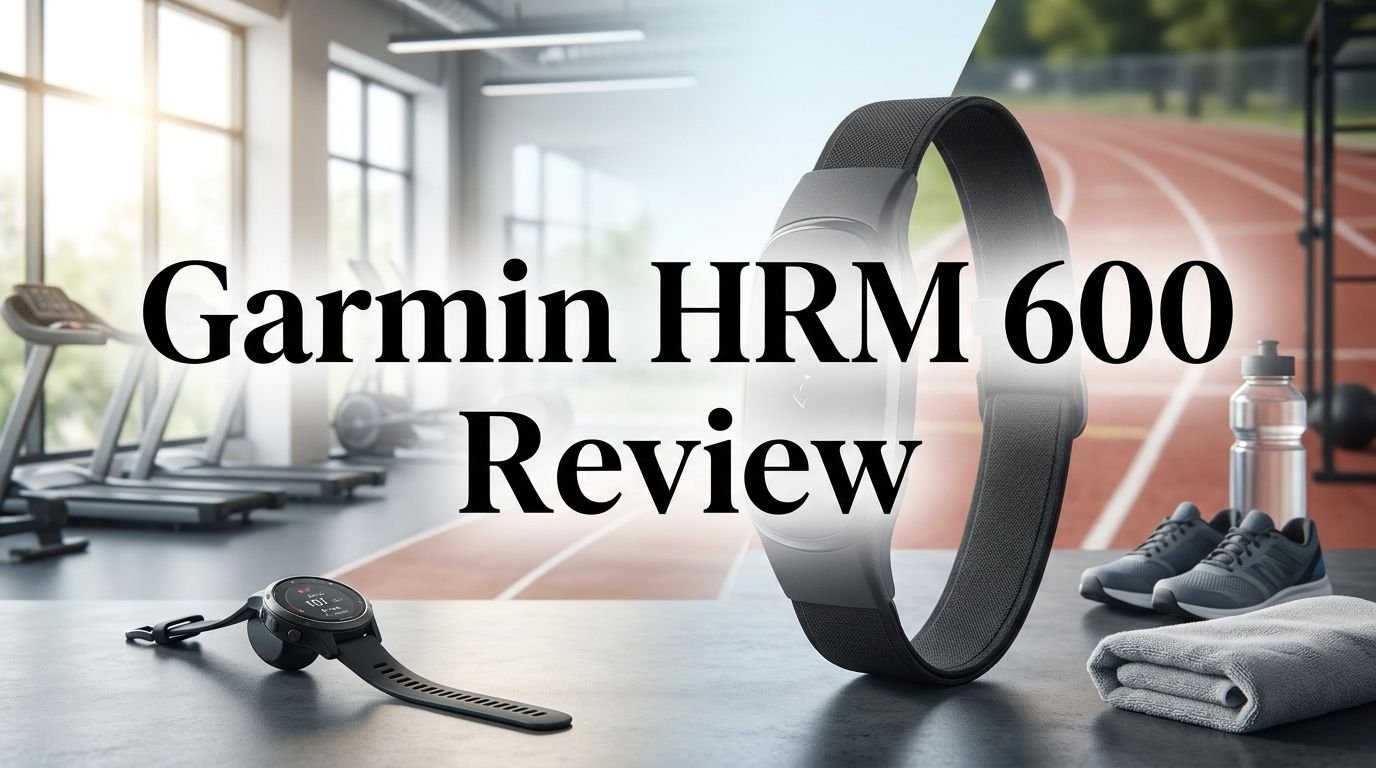
Garmin HRM 600 Review 2026: A Scam or Legit?
Are you searching for a chest strap heart rate monitor that does more than just track your heartbeat? The Garmin HRM 600 promises a lot.
It records workouts without a watch. It delivers real time heart rate and HRV data. It even tracks running dynamics and stores activity data on its own.
But does it live up to the hype? At a retail price of $169.99, the HRM 600 is the most expensive chest strap on the market. That price tag demands justification.
Key Takeaways
- The Garmin HRM 600 is Garmin’s premium chest strap heart rate monitor and the direct replacement for the HRM Pro Plus. It launched in May 2025 at a suggested retail price of $169.99.
- Standalone activity recording is the headline feature. You can record heart rate, calories, pace, distance, and more directly on the HRM 600 through the Garmin Connect app. No smartwatch is needed. This makes it perfect for team sports, martial arts, and gym classes.
- Heart rate accuracy during workouts is excellent. The ECG based sensor delivers reliable readings across running, cycling, swimming, and strength training. It matches or closely rivals the gold standard Polar H10 during exercise.
- HRV accuracy at rest is a concern. Independent testing shows the HRM 600 underestimates RMSSD values compared to the Polar H10. If you rely on precise HRV data for recovery tracking, this matters.
- The rechargeable battery lasts up to 2 months based on one hour of daily use. A quick 10 minute charge gives you about 2 hours of use in an emergency. It uses Garmin’s proprietary 4 pin charging cable.
- The detachable pod and machine washable strap are welcome design improvements. Two strap sizes (XS to S and M to XL) cover a wide range of chest measurements. The 5 ATM water rating makes it safe for swimming.

- Sends accurate real-time heart rate and HRV data to compatible Garmin smartwatches and cycling...
- Comfortable machine-washable strap is available in two sizes (XS–S and M–XL) for the most ideal...
Last update on 2026-06-28 / Affiliate links / Images from Amazon Product Advertising API Some of the links on this website are affiliate links, which means that at no additional cost to you, I earn a commission if you click through and make a purchase. I only recommend products and services that I believe will add value to my readers. Thank you for your support!
Garmin HRM 600 Overview
The Garmin HRM 600 is the company’s top tier chest strap heart rate monitor. Garmin released it in May 2025 as a replacement for the popular HRM Pro Plus. It sits above the budget friendly HRM 200 in Garmin’s lineup.
This monitor uses ECG based technology to capture heart rate data. It transmits that data over both ANT+ and Bluetooth Low Energy. You can connect it to Garmin smartwatches, Edge cycling computers, fitness equipment, and third party apps.
The biggest selling point is watch free activity recording. Athletes in contact sports or fitness classes can record full workouts through the Garmin Connect app. The data syncs later without ever needing a watch on your wrist. This feature alone separates the HRM 600 from every other chest strap on the market.
At $169.99, the HRM 600 costs more than double the Polar H10. That premium price includes a rechargeable battery, a detachable sensor pod, running dynamics support, and the standalone recording capability. The question is whether those extras justify the cost for your specific needs.
Design and Build Quality
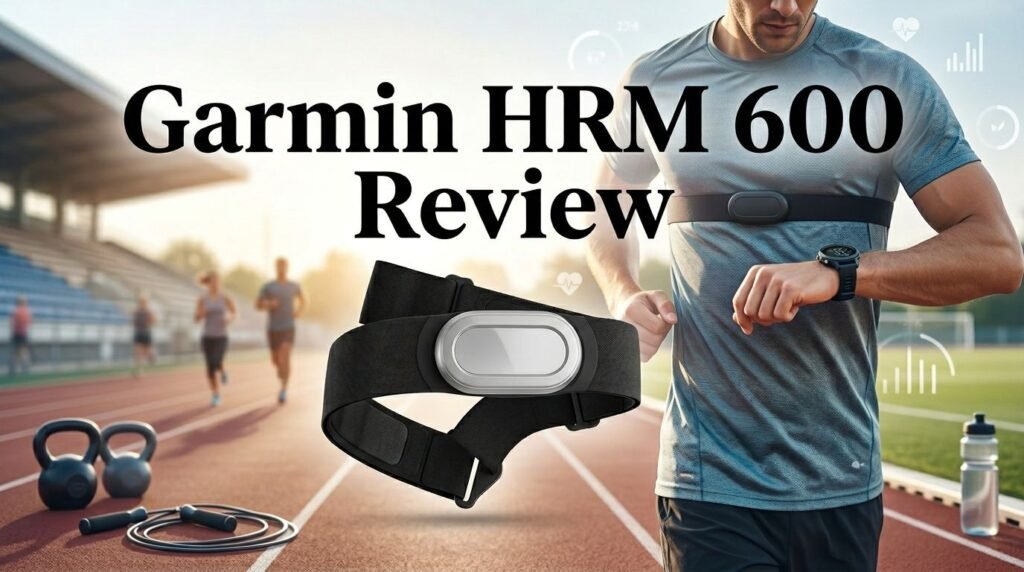
The HRM 600 features a detachable pod design. The sensor module measures 68.0 x 31.6 x 10.0 mm and weighs just 18 grams on its own. The complete unit with the M to XL strap weighs 61 grams, which is light enough to forget you are wearing it.
Garmin offers two strap sizes. The XS to S fits chest measurements from 60 to 85 cm. The M to XL covers 80 to 119 cm. The soft strap feels comfortable against skin during long workouts.
The strap connects to the pod through four connector pads and two pins. This creates a secure connection for consistent data. Removing the pod requires mild force, but the snap mechanism holds firm during intense exercise.
The charging port sits on the rear of the pod. It uses a 4 pin connector. The port lacks a protective cover, so it gets exposed to sweat and water during every workout. This is a notable design choice that could affect long term durability. You need to remove the pod from the strap to charge it.
Comfort and Fit
Comfort matters a lot for a chest strap you wear during hard workouts. The Garmin HRM 600 strap uses soft, flexible material that sits flat against your body. It does not dig in or shift around during movement.
You need to wet the electrode pads before putting the strap on. This step is important. Dry electrodes produce poor contact and unreliable readings. A splash of water or sweat activates the connection. Most experienced chest strap users already know this routine.
The adjustable hook and loop closure on the right side lets you dial in the fit. The strap should feel snug but not restrictive. A loose strap causes signal dropouts. An overly tight strap causes discomfort. Finding the sweet spot takes one or two attempts.
During long runs and cycling sessions, the HRM 600 stays in place without slipping. It performed well across gym workouts, HIIT sessions, and swimming. The lightweight pod does not bounce or create distractions during high intensity activity.
Top 3 Alternatives for Garmin HRM 600

- WORKS WITH EVERYTHING: Polar HRM works with ALL HRM compatible Equipment.
- SUPREME ACCURACY: Widely recognized for its top precision by many sources, Polar H10 is the most...

Last update on 2026-06-28 / Affiliate links / Images from Amazon Product Advertising API Some of the links on this website are affiliate links, which means that at no additional cost to you, I earn a commission if you click through and make a purchase. I only recommend products and services that I believe will add value to my readers. Thank you for your support!

- Premium heart rate strap transmits accurate real-time heart rate and heart rate variability data via...
- Captures running dynamics, such as vertical oscillation, ground contact time, stride length...
Last update on 2026-06-27 / Affiliate links / Images from Amazon Product Advertising API Some of the links on this website are affiliate links, which means that at no additional cost to you, I earn a commission if you click through and make a purchase. I only recommend products and services that I believe will add value to my readers. Thank you for your support!

- CONNECT HEART RATE TO YOUR FAVORITE TRAINING APPS AND DEVICES - Proven technology delivers accurate...
- HEART RATE, CALORIE, & TIME TRACKING - TICKR measures vital workout metrics, including heart rate...
Last update on 2026-06-27 / Affiliate links / Images from Amazon Product Advertising API Some of the links on this website are affiliate links, which means that at no additional cost to you, I earn a commission if you click through and make a purchase. I only recommend products and services that I believe will add value to my readers. Thank you for your support!
Standalone Activity Recording
The standalone recording feature is what makes the HRM 600 unique. No other Garmin chest strap can record complete workouts without a paired watch. This matters for athletes in contact sports like football, rugby, basketball, and martial arts where wearing a watch is impractical or against the rules.
Here is how it works. You open the Garmin Connect app on your phone. You select the HRM 600 device. You choose an activity type and tap to start recording. The strap then records heart rate, calories, pace, distance, and cadence. You can walk away from your phone. The data stores on the strap for up to 24 hours.
The catch? You must start the recording from your phone. The button on the pod cannot initiate a workout. If you forget to start before leaving the locker room, you have to go back. This design choice frustrates many users. A simple button press to start recording would make this feature much more practical.
Heart Rate Accuracy
Heart rate accuracy is the most important factor for any chest strap. The Garmin HRM 600 uses ECG based measurement, which captures the electrical signals from your heart. This method produces the most reliable data compared to optical wrist sensors.
During real world testing across running, cycling, swimming, and gym workouts, the HRM 600 delivers accurate heart rate readings. Comparative tests against the Polar H10 and Polar Verity Sense show the HRM 600 tracks closely with these trusted references.
The data is consistent at all intensity levels. Low heart rate zones during warm ups and cool downs match up. High heart rate readings during interval sprints and hill climbs stay accurate. There are no major dropouts or spikes during steady state cardio.
Swimming heart rate works through a store and forward system. Bluetooth and ANT+ signals do not travel through water. The HRM 600 records your heart rate during the swim and sends the data to your compatible Garmin watch after you finish. This caching method fills in the gaps and gives you a complete heart rate trace.
HRV Accuracy Concerns
Heart rate variability tracking is where the HRM 600 shows a weakness. Independent testing using the hrv4biofeedback app reveals a systematic underestimation of RMSSD values compared to the Polar H10.
The test results are clear. The HRM 600 showed a mean difference of negative 6.57 milliseconds compared to the Polar H10. The mean absolute error reached 7.68 ms and the root mean square error hit 8.40 ms. These are significant numbers for anyone who uses HRV for recovery monitoring.
In contrast, the Wahoo TRACKR HR showed a mean difference of only 0.98 ms against the same Polar H10 reference. The HRM 600 errors are roughly 2 to 3 times larger than the Wahoo competitor. This gap matters.
The likely explanation involves different signal processing algorithms. At resting heart rates around 60 bpm, the HRM 600 appears to miss or filter certain R to R intervals differently. The correlation remains strong at 0.846, meaning the trend tracking is good. But absolute accuracy falls short.
Running Dynamics
The Garmin HRM 600 captures advanced running dynamics data. These metrics include cadence, stride length, vertical oscillation, ground contact time, and ground contact time balance. A new metric called Step Speed Loss is also available with compatible watches like the Forerunner 970.
Running dynamics data transmits in real time to your paired Garmin watch. The HRM 600 uses its built in accelerometer to calculate these metrics. You see the data live on your watch screen during runs. After the workout, the full breakdown appears in Garmin Connect.
Cadence is the most actionable running metric. It tells you how many steps you take per minute. Most coaches recommend a cadence above 170 to 180 steps per minute for efficient running form. Your Garmin watch can also calculate cadence, but the chest strap provides more consistent data.
Step Speed Loss is a new metric unique to the HRM 600. It measures how much speed you lose during each step cycle. By itself, this metric has limited practical value. But it feeds into Garmin’s Running Economy metric, which measures your overall running efficiency. This is a meaningful data point for serious runners looking to improve their form.
Battery Life and Charging
The Garmin HRM 600 uses a rechargeable lithium ion battery. Garmin claims up to 2 months of battery life based on one hour of daily use. Real world testing suggests about 40 to 60 hours of active sporting use depending on the activity type.
Different activities drain the battery at different rates. Walking and hiking deliver over 60 hours. Cycling gets 35 to 53 hours. Running falls in the 40 to 60 hour range. High motion activities like gym station circuits drop to about 30 hours. The accelerometer uses more power during intense movement.
Charging uses Garmin’s proprietary 4 pin cable. The same cable works for many Garmin watches and devices. A full charge takes a couple of hours. An emergency 10 minute charge gives you about 2 hours of use. That quick charge feature is genuinely useful if you realize the battery is low right before a workout.
The switch from a coin cell battery to rechargeable is a mixed upgrade. The old HRM Pro Plus used a CR2032 battery that lasted up to 12 months. You never had to think about charging. The HRM 600 needs regular charging every few weeks. On the positive side, you never need to buy replacement batteries. You also avoid opening the battery door, which can compromise the waterproof seal over time.
Connectivity and Compatibility
The HRM 600 supports dual protocol connectivity. It broadcasts over ANT+ with no limit on concurrent connections. It also supports up to three simultaneous Bluetooth Low Energy connections. This flexibility lets you pair with your watch, phone, and a treadmill all at the same time.
Garmin has added Secure BLE connections to the HRM 600. This encrypted connection addresses European privacy regulations. Compatible Garmin devices can receive data through this protected channel. The feature adds an extra step during pairing, which some users find annoying.
The HRM 600 works with the full Garmin ecosystem. It pairs with Garmin smartwatches including the Forerunner, Fenix, Epix, and Enduro series. It connects to Edge cycling computers. It works with the Tacx Training app. Third party fitness apps and gym equipment that support ANT+ or Bluetooth can also receive heart rate data.
Setup and Ease of Use
Setting up the HRM 600 for the first time requires a simple activation step. Connect it to a power source for 2 seconds, then unplug it. The device is now ready for pairing.
Putting on the strap follows a consistent routine. Snap the pod onto the strap. Wet the electrode pads. Place the strap around your chest below your pectoral muscles. Connect the hook and loop on the right side. Adjust for a snug fit. The pod should sit at the center of your chest with the GARMIN text facing outward.
The LED indicator on the pod communicates status information. Green means everything works correctly. Red signals an issue. Blue flashes indicate a workout recording in progress. The LED sits on the front of the pod rather than the top. This placement makes it harder to see while wearing the strap.
The button on the pod serves three functions. A single press wakes up the device. A double press toggles between Secure and Open Bluetooth. A press and hold for 4 seconds enters pairing mode. The button cannot start or stop a workout recording, which is the biggest usability gap.
Swimming Performance
The HRM 600 carries a 5 ATM water resistance rating. This means it handles pool swimming, open water swimming, and even wetsuit use without issues. The waterproof seals around the pod connectors keep water out.
Heart rate tracking in water works through a cache and forward system. Radio signals do not pass through water effectively. The HRM 600 records your heart rate data continuously during the swim. After you finish and save the activity on your compatible Garmin watch, the cached data transfers to fill in the full heart rate trace.
This caching feature works reliably at the end of the swim activity. The watch recognizes the saved data and merges it with any readings it captured during rest periods or when your chest was above water. The result is a complete heart rate profile for your entire swim.
Pool swimming and open water swimming both benefit from this feature. Triathletes in particular find value here. You get accurate heart rate zones for the swim leg without wearing a separate armband sensor.
Price and Value
The Garmin HRM 600 retails at $169.99. This makes it the most expensive standalone chest strap heart rate monitor on the market. The price exceeds the Polar H10 by more than double and costs significantly more than the Wahoo TICKR or COROS Heart Rate Monitor.
What you get for the premium price includes a rechargeable battery, standalone activity recording, running dynamics support, Secure BLE connections, swimming heart rate caching, a detachable and washable strap, and the new Step Speed Loss metric.
If you are a triathlete or multi sport athlete, the HRM 600 delivers genuine value. The combination of swimming heart rate caching, running dynamics, and standalone recording covers every sport. No other single chest strap offers this full feature set.
Team sport athletes benefit the most from standalone recording. Football, basketball, rugby, soccer, and martial arts participants can track full workout data without any watch. This is a unique capability that justifies the premium for the right user.
However, if you only run or cycle and already own a Garmin watch, the HRM 600 offers little over the cheaper HRM 200. Your watch handles running dynamics. You do not need standalone recording. The Polar H10 provides equal or better accuracy at a much lower price point.
Who Should Buy the Garmin HRM 600
The HRM 600 is not for everyone. Its premium price and advanced feature set target specific types of athletes. Here is a breakdown of who benefits most from this purchase.
Buy the HRM 600 if you participate in team sports or contact sports where watches are impractical. The standalone recording feature is a genuine problem solver. No other device offers this level of data capture without a wrist worn watch.
Triathletes and swimmers should strongly consider the HRM 600. The swimming heart rate cache works seamlessly with compatible Garmin watches. Combined with running dynamics, you get comprehensive data across all three disciplines.
Skip the HRM 600 if you are a casual runner or cyclist who already wears a Garmin watch. The HRM 200 or Polar H10 gives you accurate heart rate data for a lot less money. The extra features of the HRM 600 will go unused.
Pros and Cons Summary
What the HRM 600 does well. The heart rate accuracy during exercise is excellent. The standalone recording feature fills a real gap for watch free athletes.
The rechargeable battery eliminates the need for coin cell replacements. The detachable pod and washable strap improve hygiene. The 5 ATM water rating handles any water sport. Running dynamics and Step Speed Loss add meaningful data for serious runners.
What the HRM 600 gets wrong. The price is the highest on the market for a chest strap. HRV accuracy at rest falls below the Polar H10 standard. The button cannot start a workout recording.
The charging port is exposed and hard to access. The secure connection pairing process adds unnecessary steps. The 24 hour recording limit feels short for multi day use. The LED indicator placement on the front of the pod is hard to see while wearing the strap.
Final Verdict
The Garmin HRM 600 is a significant step forward for chest strap heart rate monitors. It offers features that no competitor can match. Standalone recording, rechargeable battery, running dynamics, and swimming heart rate caching all live in one package.
The heart rate accuracy during workouts meets professional grade standards. You can trust the data it produces during runs, rides, swims, and gym sessions. The comfort and build quality match the premium price.
The main drawbacks are usability related rather than technical. The inability to start recordings with the button, the exposed charging port, and the secure connection workflow all need improvement. These issues do not break the product, but they reduce the joy of using it.
At $169.99, the HRM 600 is only worth the investment if you will use its unique features. Team sport athletes and triathletes get real value here. Runners and cyclists who already wear a Garmin watch will find better value elsewhere.
Frequently Asked Questions
Can I use the Garmin HRM 600 without a Garmin watch?
Yes. The HRM 600 can record activities through the Garmin Connect app on your phone. It also works as a standard heart rate sensor with any ANT+ or Bluetooth compatible device, app, or gym equipment. You do not need a Garmin watch.
How long does the Garmin HRM 600 battery last?
Garmin rates the battery at up to 2 months with one hour of daily use. Real world testing shows 40 to 60 hours of active use for running and cycling. High motion activities like gym circuits may get closer to 30 hours. A 10 minute emergency charge provides about 2 hours of use.
Is the Garmin HRM 600 good for swimming?
Yes. The HRM 600 has a 5 ATM water rating and works in both pool and open water. It caches heart rate data during swimming and forwards it to your compatible Garmin watch after the activity ends. This gives you a complete heart rate trace for the swim.
What is the difference between Garmin HRM 600 and HRM 200?
The HRM 600 costs $169.99 while the HRM 200 costs much less. The HRM 600 adds standalone activity recording, running dynamics, Step Speed Loss metric, Secure BLE connections, a rechargeable battery, and a detachable pod design. The HRM 200 is a basic heart rate strap with a rechargeable battery and 3 ATM water resistance. Both deliver accurate heart rate data.
Is the Garmin HRM 600 better than the Polar H10?
It depends on your needs. The HRM 600 offers more features including standalone recording and running dynamics. The Polar H10 delivers better HRV accuracy at rest and costs significantly less. For general workout heart rate tracking, both perform at a similar level. For HRV research and recovery monitoring, the Polar H10 is the better choice.
Does the Garmin HRM 600 strap fit all body sizes?
Garmin offers two strap sizes. The XS to S fits chest measurements from 23.5 to 33.5 inches. The M to XL fits 31.5 to 47 inches. Make sure you measure your chest and select the correct size before purchasing.

Hi, I’m Elowen Porter, the creator of GreenLight.blog.
I share honest reviews and insights on supplements and Amazon health products to help you make smarter wellness choices.
With a passion for natural living and evidence-based products, I dig deep to find what truly works.
My goal is to simplify your supplement search with real results and trusted recommendations.
Let’s make healthy living a little easier—one product at a time.