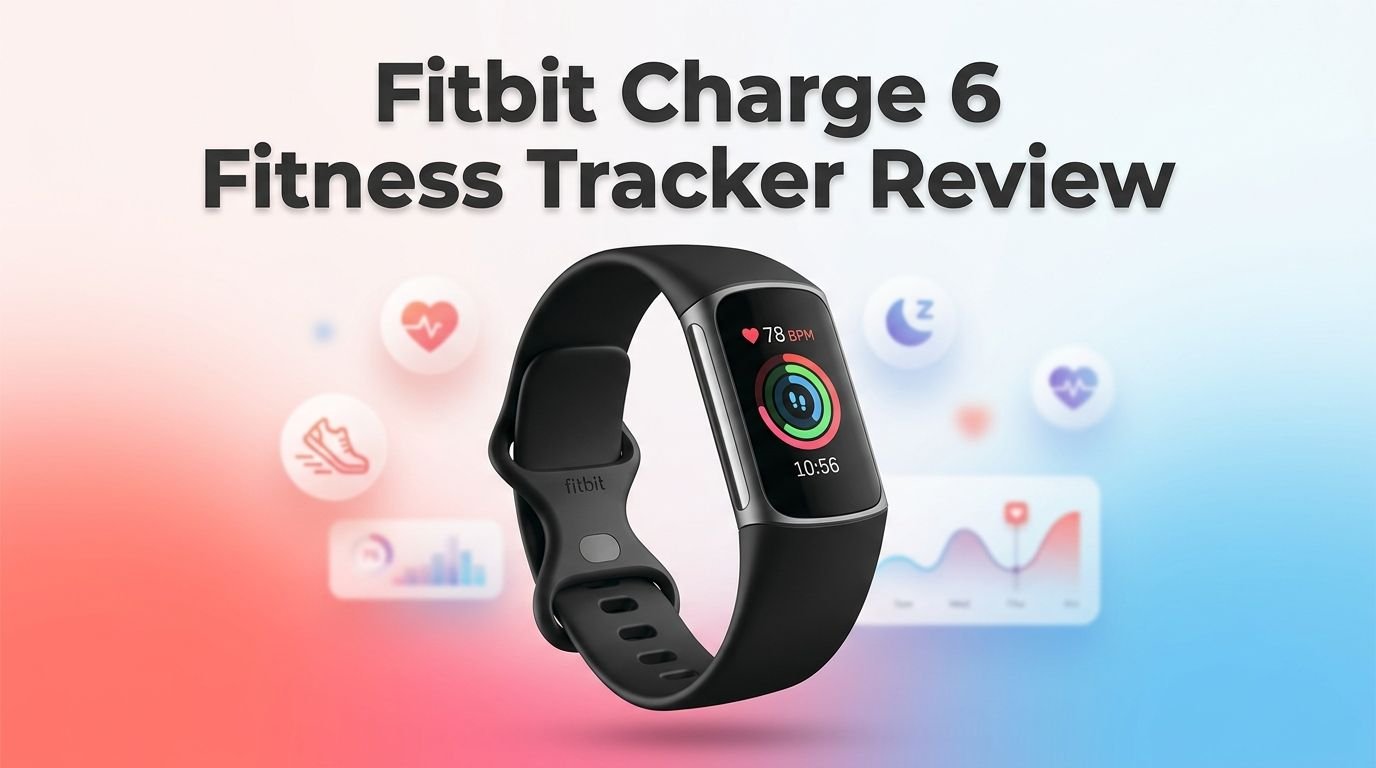
Fitbit Charge 6 Fitness Tracker Review 2026: Worth Your Money?
So you are thinking about buying a fitness tracker in 2026 and the Fitbit Charge 6 keeps popping up everywhere. You are not alone. This little wristband has been one of the most popular fitness trackers since its launch in October 2023. But does it still hold up today?
The Charge 6 sits at a sweet spot between a basic fitness band and a full smartwatch. It packs Google integration, built in GPS, ECG monitoring, and SpO2 tracking into a slim, comfortable design. Priced at around $159.95 at launch, you can now find it at even better prices online.
Whether you are a gym regular, a casual jogger, or someone who just wants to keep tabs on daily health metrics, this tracker has something for you.
Key Takeaways:
- The Fitbit Charge 6 offers Fitbit’s most accurate heart rate sensor yet, delivering up to 60% better accuracy during high intensity workouts like HIIT compared to older models. This makes it a solid choice for serious fitness tracking.
- Google integration sets it apart from competitors. You get access to Google Maps turn by turn directions, Google Wallet for contactless payments, and YouTube Music control right from your wrist. No other fitness band in this price range offers this level of smart features.
- Battery life lasts up to 7 days on a single charge. This is impressive for a tracker with built in GPS and an AMOLED display. Most users report getting 5 to 6 days with regular GPS use and always on display turned off.
- Health monitoring goes beyond the basics. The Charge 6 includes ECG heart rhythm assessment, SpO2 blood oxygen monitoring, EDA stress scans, skin temperature tracking, and irregular heart rhythm notifications. It covers all major health metrics in one small package.
- The physical side button returns from the Charge 4 era, making it much easier to pause workouts and navigate menus compared to the touch only design of the Charge 5. Users have praised this change across the board.
- Sleep tracking remains one of Fitbit’s strongest features, providing detailed sleep stages, sleep scores, and a Daily Readiness Score to help you plan your activity levels each morning.

- Fitbit Charge 6 tracks key metrics from calories and Active Zone Minutes to Daily Readiness and...
- See your heart rate in real time: Just link your Charge 6 to compatible exercise machines, like...

Last update on 2026-06-27 / Affiliate links / Images from Amazon Product Advertising API Some of the links on this website are affiliate links, which means that at no additional cost to you, I earn a commission if you click through and make a purchase. I only recommend products and services that I believe will add value to my readers. Thank you for your support!
Fitbit Charge 6 Fitness Tracker: Design and Build Quality
The Fitbit Charge 6 keeps the slim band design that made its predecessors so popular. It measures just 1.45 inches long, 0.91 inches wide, and 0.44 inches thick. You can wear it all day and forget it is even there.
The aluminum case gives the tracker a premium feel without adding unnecessary weight. It comes in three color options: Obsidian/Black, Coral/Champagne Gold, and Porcelain/Silver. Each one looks clean and modern on the wrist.
One of the biggest design upgrades is the return of the physical side button. The Charge 5 went fully touch based, and many users found it frustrating during workouts. The tactile button on the Charge 6 lets you pause exercises and navigate menus with a simple press. This was a smart move by Fitbit.
The 1.04 inch AMOLED display is bright and colorful. It is easy to read outdoors in direct sunlight. The touch response is smooth and quick. You can customize the watch face through the Fitbit app to match your style.
The band uses a standard clasp mechanism that feels secure on the wrist. Replacement bands are widely available and easy to swap. The tracker is water resistant up to 50 meters, so you can wear it in the shower, pool, or ocean without worry.
Overall, the Charge 6 looks and feels like a well built fitness tracker. It balances comfort and durability in a way that makes it great for 24/7 wear.
Heart Rate Monitoring and Accuracy
The Fitbit Charge 6 features Fitbit’s most advanced optical heart rate sensor in a tracker form factor. Google claims it delivers up to 60% more accurate readings during vigorous activities like HIIT, spinning, and circuit training compared to the Charge 5.
In real world use, the heart rate data closely matches dedicated chest strap monitors during steady state cardio like running and cycling. The accuracy does dip slightly during exercises with heavy wrist movement, such as boxing or kettlebell swings. But this is common across all wrist based trackers.
The 24/7 continuous heart rate monitoring tracks your resting heart rate throughout the day. You get high and low heart rate notifications that alert you if your heart rate goes above or below custom thresholds while you are inactive. This is a genuinely useful health safety feature.
Active Zone Minutes is another standout feature. The tracker uses your heart rate data to tell you how much time you spend in fat burn, cardio, and peak heart rate zones. It buzzes on your wrist when you move between zones during a workout. This real time feedback helps you adjust your intensity on the fly.
One unique feature is Heart Rate on Exercise Equipment. You can connect the Charge 6 to compatible gym machines via Bluetooth. Your real time heart rate appears on the machine’s display. This works with brands like Peloton, NordicTrack, and Life Fitness. It is a small but practical feature for gym goers.
Display and User Interface
The Charge 6 uses a 1.04 inch AMOLED touchscreen with a resolution that produces sharp, vibrant colors. Text is crisp and icons are easy to identify. The always on display option is available but it does reduce battery life by a couple of days.
Navigation follows a swipe based system. Swipe left or right from the main clock face to access tiles like Notifications, Exercise, Alarms, Timers, EDA Scan, ECG, Google Maps, and Google Wallet. Swipe down to see quick settings and swipe up for your daily stats.
The side button adds another layer of control. A single press takes you back to the clock face from any screen. During workouts, you press it to pause or stop an exercise. This physical interaction feels more reliable than trying to tap a sweaty touchscreen mid run.
Watch faces are customizable through the Fitbit app. You can choose from dozens of designs and pick which data points appear on your main screen. Options include steps, heart rate, calories, active zone minutes, and weather.
The screen brightness adjusts automatically, but you can also set it manually. Outdoor visibility is solid for a screen this size. You will not struggle to read your stats during a sunny afternoon jog.
The interface is simple and straightforward. Even first time fitness tracker users will feel comfortable after a few hours. There is no steep learning curve here.
Top 3 Alternatives for Fitbit Charge 6
1. Garmin Vivosmart 5

- Easy-to-use, comfortable smart fitness tracker, once setup through the Garmin Connect app, has a...
- Get an uninterrupted picture of your health with up to 7 days of battery life in smartwatch mode...
Last update on 2026-06-27 / Affiliate links / Images from Amazon Product Advertising API Some of the links on this website are affiliate links, which means that at no additional cost to you, I earn a commission if you click through and make a purchase. I only recommend products and services that I believe will add value to my readers. Thank you for your support!
2. Samsung Galaxy Fit 3
![SAMSUNG Galaxy FIT 3 [2024] 1.6' AMOLED Display | 14 Days Battery Life | 100+ Watchfaces | 100+ Exercise Modes | International Model - (Gray)](https://greenlight.blog/wp-content/plugins/aawp/public/image.php?url=YUhSMGNITTZMeTl0TG0xbFpHbGhMV0Z0WVhwdmJpNWpiMjB2YVcxaFoyVnpMMGt2TXpGS2VVNDNTR3RDT0V3dWFuQm58MTc4NDc3ODYxOA=)
- Vibrant 1.6” AMOLED Display – Large, high-res screen with smooth touch for easy navigation
- 5ATM & IP68 Water Resistance – Swim-ready and dust-resistant for active lifestyles
Last update on 2026-06-27 / Affiliate links / Images from Amazon Product Advertising API Some of the links on this website are affiliate links, which means that at no additional cost to you, I earn a commission if you click through and make a purchase. I only recommend products and services that I believe will add value to my readers. Thank you for your support!
3. Amazfit Band 7

- 【Large HD AMOLED Display】 Amazfit band 7 fitness tracker features a large 1.47” always-on...
- 【18-day Battery Life】 Say goodbye to daily recharge. When fully charged, the 232 mAh battery of...
Last update on 2026-06-27 / Affiliate links / Images from Amazon Product Advertising API Some of the links on this website are affiliate links, which means that at no additional cost to you, I earn a commission if you click through and make a purchase. I only recommend products and services that I believe will add value to my readers. Thank you for your support!
Built in GPS Performance
The Fitbit Charge 6 has built in GPS with support for GPS and GLONASS satellite systems. This means you can leave your phone at home during outdoor runs, walks, and bike rides. The tracker records your route, pace, and distance independently.
GPS lock time is generally fast. In open areas, the Charge 6 picks up a signal within 10 to 30 seconds. In dense urban areas with tall buildings, it may take a bit longer. Starting your activity in an open space helps speed things up.
Route accuracy is good but not perfect. For casual runners and walkers, the mapped routes closely match actual paths. You might see occasional drift on tight turns or heavily tree covered trails. Serious runners who need pinpoint accuracy may prefer a dedicated GPS running watch.
The post workout map view in the Fitbit app shows your route with color coded pace or heart rate zones. This visual feedback is helpful for analyzing your outdoor sessions. You can zoom in and review specific segments of your run.
Google Maps integration adds another GPS powered feature. You get turn by turn directions on your wrist. This is useful for navigating new running routes or cycling paths without pulling out your phone. The directions are clear and easy to follow on the small screen.
Battery drain during GPS use is noticeable. Expect to lose about a full day of battery life per hour of GPS tracking. If you run with GPS for 30 minutes daily, you will likely charge the tracker every 4 to 5 days instead of 7.
Sleep Tracking and Sleep Score
Fitbit has long been a leader in sleep tracking, and the Charge 6 continues that tradition. The tracker automatically detects when you fall asleep and wake up. It records your time in light sleep, deep sleep, and REM sleep stages throughout the night.
Each morning, you receive a Sleep Score out of 100. This score combines your sleep duration, sleep quality, and restoration data into a single easy to understand number. A score above 80 generally means you had a good night’s rest. Below 60 suggests room for improvement.
The Sleep Profile feature (available with Fitbit Premium) goes deeper. It analyzes your sleep patterns over time and assigns you a sleep animal profile like Bear, Dolphin, Giraffe, or Tortoise. Each profile comes with personalized tips to improve your sleep habits.
Skin temperature tracking during sleep can reveal patterns that may indicate illness, hormonal changes, or environmental factors affecting your rest. The Charge 6 measures temperature variations from your personal baseline and presents trends over time.
Snoring detection is also available. The tracker uses your phone’s microphone to estimate snoring and noise levels in your sleep environment. This data can be eye opening for people who do not realize they snore.
While some users have reported occasional inaccuracies with sleep stage detection, the overall sleep data from Fitbit remains among the best in the fitness tracker category. It gives you a clear picture of your sleep health over weeks and months.
Workout Tracking and Exercise Modes
The Fitbit Charge 6 comes loaded with over 40 exercise modes. These cover a wide range of activities including running, cycling, swimming, HIIT, yoga, weight training, elliptical, rowing, pilates, and more.
You can set a few favorite exercises for quick access from the workout tile on the tracker. The rest are available through the exercise settings in the Fitbit app. Auto exercise detection recognizes activities like walking, running, cycling, and swimming if you forget to start a workout manually.
During a workout, the display shows real time metrics. For a run, you see elapsed time, distance, pace, heart rate, and active zone minutes. For strength training, you see heart rate, elapsed time, and calories burned. The data shown varies by exercise type.
The interval training mode is a useful addition. You can set custom work and rest periods directly from the tracker. It buzzes your wrist when each interval starts and ends. This is great for HIIT sessions or structured running workouts.
Post workout summaries appear on both the tracker and the Fitbit app. The app provides detailed breakdowns with charts for heart rate zones, pace splits, calorie burn, and more. You can review your exercise history over days, weeks, and months to spot trends.
Swimming tracking deserves a mention. The Charge 6 is water resistant to 50 meters and tracks pool swims with lap counting and duration. It does not track open water swims with the same level of detail, but it handles pool sessions well.
Google Apps Integration
The Google integration is one of the biggest selling points of the Charge 6. This is the first Fitbit tracker to bring Google apps directly to a fitness band form factor.
Google Maps on the Charge 6 provides turn by turn navigation. Pair it with your phone and you get directions right on your wrist. It vibrates before each turn and shows a simple arrow with street names. For runners and cyclists exploring new routes, this feature is a game changer.
Google Wallet lets you make contactless payments with a flick of your wrist. Tap the Charge 6 on any NFC payment terminal at stores, coffee shops, or transit stations. Setup is done through the Fitbit app and works with most major credit and debit cards.
YouTube Music control is available for Premium subscribers. You can play, pause, skip tracks, and adjust volume from the tracker. You can also download playlists for offline listening through the Fitbit app. This means you can leave your phone behind on a run and still enjoy your music.
These Google features push the Charge 6 beyond a simple fitness tracker. They add everyday convenience that you would typically only find on a full smartwatch. For Google ecosystem users, this integration feels natural and well implemented.
The Fitbit app itself runs on both Android and iOS. It syncs data from the Charge 6 and presents health and fitness information in clean, easy to read dashboards. The app experience is smooth and well organized.
Health Monitoring Features
- Fitbit Charge 6 tracks key metrics from calories and Active Zone Minutes to Daily Readiness and...
- See your heart rate in real time: Just link your Charge 6 to compatible exercise machines, like...
Last update on 2026-06-27 / Affiliate links / Images from Amazon Product Advertising API Some of the links on this website are affiliate links, which means that at no additional cost to you, I earn a commission if you click through and make a purchase. I only recommend products and services that I believe will add value to my readers. Thank you for your support!
Beyond heart rate, the Charge 6 packs a serious set of health monitoring tools. These features help you keep track of your body’s signals over time.
The ECG app records your heart rhythm and checks for signs of atrial fibrillation (AFib). You place your finger on the side button and hold still for 30 seconds. The results are stored in the Fitbit app and can be shared with your doctor. This is a meaningful feature for users with heart health concerns.
SpO2 monitoring tracks your blood oxygen saturation levels during sleep. Low SpO2 readings over time can indicate breathing issues or other health conditions. The data appears in the Fitbit app’s health dashboard as a nightly trend graph.
The EDA (Electrodermal Activity) Scan measures tiny electrical changes on your skin that relate to stress responses. You cover the screen with your palm for two minutes while the sensor takes readings. It then shows your number of EDA responses and helps guide you through a calming breathing session.
Skin temperature variation tracking compares your nightly readings to your personal baseline. Shifts in skin temperature can signal the onset of illness, menstrual cycle changes, or other physiological shifts. This data is most useful when viewed over weeks.
You also get irregular heart rhythm notifications. The Charge 6 periodically checks your heart rhythm in the background and alerts you if something looks unusual. This is not a replacement for medical monitoring but adds an extra layer of awareness.
The Daily Readiness Score tells you each morning whether your body is ready for intense activity or if you should take a rest day. It uses sleep, heart rate variability, and recent activity data to generate a score. This helps prevent overtraining.
Battery Life and Charging
Fitbit advertises up to 7 days of battery life for the Charge 6. In practice, most users get between 5 and 7 days depending on usage patterns. Heavy GPS use, always on display, and frequent notifications will push you closer to the 5 day mark.
If you keep the always on display turned off and limit GPS sessions, you can comfortably hit the full 7 day mark. Sleep tracking and continuous heart rate monitoring run in the background without a major battery impact.
The Charge 6 uses a proprietary magnetic charging cable. It snaps onto the back of the tracker and charges from zero to full in about one to two hours. A quick 15 minute charge gives you enough juice for a full day. That is convenient when you are in a rush.
One drawback is the proprietary charger itself. If you lose it, you need to buy a specific replacement. Universal charging options like USB C or Qi wireless charging would be welcome in future models. Thankfully, third party chargers are available on Amazon at affordable prices.
Battery performance does degrade slightly over time, as with any rechargeable device. After a year or two of daily use, you may notice the battery lasting a day or two less than when it was new. This is normal and expected.
For most people, the battery life is more than adequate. Charging once a week fits easily into most routines. It is a significant advantage over smartwatches that need daily or every other day charging.
Fitbit Premium Membership: Is It Worth It?
The Charge 6 comes with a 6 month free trial of Fitbit Premium. After that, the subscription costs about $9.99 per month or $79.99 per year. But what do you actually get?
Fitbit Premium unlocks detailed health reports, advanced sleep analytics, guided workouts, and mindfulness sessions. The Daily Readiness Score and Sleep Profile features also require a Premium subscription to access full details.
The Health Metrics dashboard in Premium shows trends for breathing rate, heart rate variability, skin temperature, and SpO2 over time. Free users only see a limited snapshot. Premium members get 30 day and 90 day trend views with more context.
Guided workout videos from brands like POPSUGAR Fitness, Daily Burn, and others are included. You get hundreds of sessions ranging from yoga and meditation to HIIT and strength training. These play directly in the Fitbit app on your phone.
Is it worth the price? That depends on your goals. If you just want basic step counting, heart rate tracking, and workout logging, the free tier covers the essentials. But if you want deeper health insights and personalized guidance, Premium adds genuine value.
Many users keep Premium for the first year and then decide based on how much they actually use the advanced features. The 6 month free trial gives you plenty of time to evaluate.
Fitbit Charge 6 vs Fitbit Charge 5
The Charge 6 is a clear upgrade over the Charge 5 in several areas. Here is what changed.
The most obvious improvement is the physical side button. The Charge 5 relied entirely on a touch interface, which many users found unreliable during sweaty workouts. The Charge 6 brings back the tactile button and it makes a real difference in daily use.
Heart rate accuracy improved by up to 60% during high intensity activities. The Charge 6 uses an upgraded optical sensor that provides more reliable data during exercises with rapid movement. This is one of the most meaningful hardware upgrades.
Google apps are new to the Charge 6. The Charge 5 did not support Google Maps, Google Wallet, or YouTube Music. These additions bring the Charge 6 closer to smartwatch territory while keeping the slim band form factor.
The Charge 6 also adds Heart Rate on Exercise Equipment via Bluetooth. This feature did not exist on the Charge 5. It lets you broadcast your heart rate to compatible gym machines for a more connected workout experience.
In terms of design, both trackers look similar. The display size and resolution are nearly identical. The Charge 6 is marginally thicker due to the button, but the difference is barely noticeable on the wrist.
Pricing favors the Charge 6 as well. It launched at $159.95, which was actually $20 less than the Charge 5’s original retail price. Now that the Charge 6 has been on the market for over two years, you can often find it discounted even further.
Who Should Buy the Fitbit Charge 6?
The Fitbit Charge 6 is ideal for a wide range of users. But it fits some lifestyles better than others.
Casual fitness enthusiasts will love it. If you want to track steps, monitor heart rate, log workouts, and check sleep quality without wearing a bulky smartwatch, the Charge 6 delivers. Its slim design and long battery life make it a great everyday companion.
Gym goers benefit from the Heart Rate on Exercise Equipment feature and the 40 plus exercise modes. The interval training mode and real time heart rate zone feedback add extra value during structured workouts.
Health conscious individuals who want to monitor ECG, SpO2, stress, and skin temperature will appreciate the depth of health features packed into this small device. It provides data that was only available on much more expensive devices a few years ago.
Google ecosystem users get the most out of this tracker. If you already use Google Maps, Google Wallet, and YouTube Music, the Charge 6 integrates smoothly into your digital life.
However, the Charge 6 is not the best pick for serious athletes who need advanced running dynamics, multi sport tracking, or ultra precise GPS mapping. A dedicated GPS running watch from Garmin or COROS would serve those needs better.
It is also not ideal for people who want a large screen for reading texts and emails at length. The display is functional but small. If you want a bigger screen, consider a smartwatch like the Google Pixel Watch or Apple Watch.
Pros and Cons of the Fitbit Charge 6
Every product has strengths and weaknesses. Here is an honest summary of the Charge 6.
The pros are significant. The heart rate sensor delivers impressive accuracy for a fitness band. Google apps bring real smartwatch features to a slim tracker form factor. Battery life of 5 to 7 days means less time tethered to a charger. The physical side button dramatically improves usability. And the health monitoring suite is one of the most complete you will find in this category.
The cons are worth noting too. The display is small, which limits how much information you can see at once. The proprietary charging cable is easy to misplace and cannot be replaced with a universal charger. Some premium features like the Daily Readiness Score and Sleep Profile require a paid Fitbit Premium subscription.
A few users have reported occasional issues with sleep tracking accuracy, particularly with detecting awake periods during the night. Software updates have improved this over time, but it is not flawless.
The Fitbit app has also undergone changes since Google’s acquisition. Some legacy features like challenges and certain in app graphs have been removed. This has frustrated long time Fitbit users who relied on those features.
Despite these drawbacks, the overall package remains strong. The Charge 6 offers excellent value for the price, especially now that it is available at discounted rates across major retailers.
Final Verdict: Should You Buy the Fitbit Charge 6 in 2026?
The Fitbit Charge 6 remains a top tier fitness tracker heading into 2026. It balances health tracking, workout logging, smart features, and battery life better than most competitors in the fitness band category.
Yes, it has been on the market since late 2023. But the hardware is still capable and Fitbit continues to push software updates that refine the experience. The Google integration gives it a modern edge that many newer budget trackers still lack.
At its current discounted price, the Charge 6 offers outstanding value. You get ECG, SpO2, GPS, Google Maps, Google Wallet, and YouTube Music in a device that lasts nearly a week on a single charge. That is hard to beat.
If you are looking for a reliable, feature packed fitness tracker that does not take up your whole wrist, the Fitbit Charge 6 is an easy recommendation. It is one of the best fitness bands you can buy today.
Frequently Asked Questions
Is the Fitbit Charge 6 waterproof?
The Fitbit Charge 6 is water resistant up to 50 meters. You can wear it while swimming in a pool, showering, or getting caught in the rain. It is not rated for high velocity water activities like water skiing or deep sea diving. For everyday water exposure and pool swimming, it handles everything without issues.
Does the Fitbit Charge 6 work with iPhone?
Yes, the Fitbit Charge 6 is compatible with both Android and iOS devices. You download the Fitbit app from the App Store and pair the tracker via Bluetooth. Most features work the same on both platforms. However, Google Wallet setup and some notification features may work slightly better on Android.
How accurate is the Fitbit Charge 6 heart rate monitor?
The Charge 6 uses Fitbit’s most advanced optical heart rate sensor in a fitness band. It is up to 60% more accurate during intense workouts compared to the Charge 5. For steady state cardio and resting heart rate, accuracy is very close to chest strap monitors. During high wrist movement exercises, accuracy may vary slightly.
Can I make calls or send texts from the Fitbit Charge 6?
No, the Fitbit Charge 6 does not support phone calls or text replies. You can receive and read notifications for calls, texts, and app alerts on the screen. But you cannot respond to them directly from the tracker. For call and text functionality, you would need a full smartwatch.
Does the Fitbit Charge 6 have a built in GPS?
Yes, the Charge 6 has built in GPS with GLONASS support. You can track outdoor runs, walks, and bike rides without carrying your phone. The tracker records your route, pace, and distance. After your workout, you can view a map of your route in the Fitbit app with color coded metrics.
How long does the Fitbit Charge 6 battery last?
Fitbit rates the Charge 6 for up to 7 days of battery life. Real world usage typically falls between 5 and 7 days depending on features like GPS, always on display, and notification frequency. A full charge takes about one to two hours using the included magnetic charging cable.

Hi, I’m Elowen Porter, the creator of GreenLight.blog.
I share honest reviews and insights on supplements and Amazon health products to help you make smarter wellness choices.
With a passion for natural living and evidence-based products, I dig deep to find what truly works.
My goal is to simplify your supplement search with real results and trusted recommendations.
Let’s make healthy living a little easier—one product at a time.