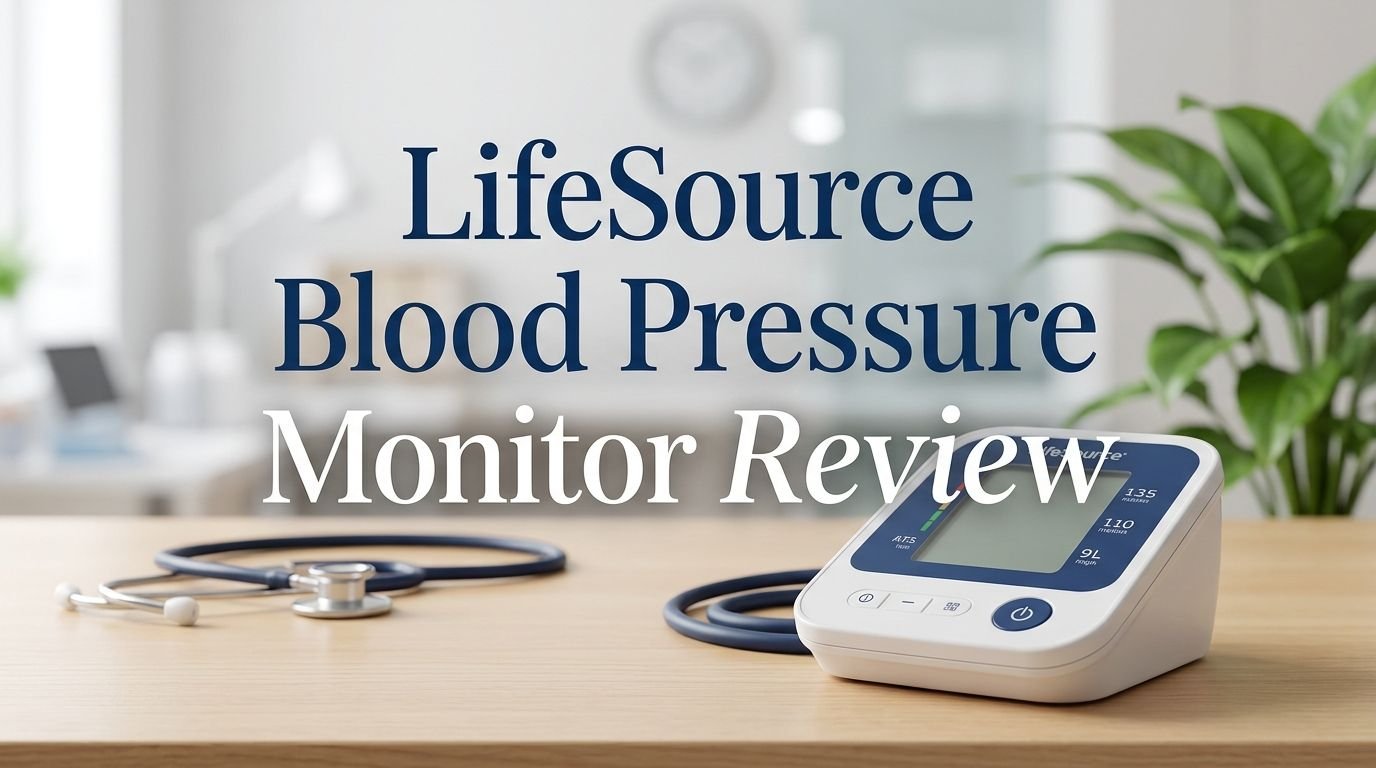
LifeSource Blood Pressure Monitor Review 2026: Worth Your Money?
Your doctor just told you to start tracking your blood pressure at home. You searched online and found dozens of options. Now you feel stuck. LifeSource blood pressure monitors have been a trusted name in home health care for over 30 years.
But do they still hold up in 2026? This detailed review breaks down everything you need to know about LifeSource monitors, from accuracy and features to real user experiences and pricing.
Whether you have hypertension, a heart condition, or simply want to stay on top of your health, this guide will help you make a smart choice. Keep reading to find out if a LifeSource monitor belongs in your home.
Key Takeaways
- LifeSource is now part of A&D Medical, one of the most respected names in clinical-grade health monitoring devices. The monitors carry the same trusted technology that hospitals and clinics use worldwide.
- Clinical validation is a standout feature. Most LifeSource monitors meet the accuracy standards set by the AAMI, BHS, and ESH. This means your home readings will closely match those taken at a doctor’s office.
- Multiple cuff sizes are available. LifeSource offers standard, wide-range, and extra-large cuffs. This makes their monitors suitable for people with arm sizes ranging from 6.3 inches to 23.6 inches.
- The 5-year warranty is one of the longest in the industry. Most competitors only offer 1 to 3 years. This gives you extra peace of mind about your purchase.
- Irregular heartbeat detection comes standard on most mid-range and premium models. This feature flags potential heart rhythm issues during a reading, giving you early warning signs.
- Prices range from about $40 to $100, depending on the model and features. FSA and HSA accounts can typically cover the cost, making these monitors even more affordable.

What Is a LifeSource Blood Pressure Monitor?
A LifeSource blood pressure monitor is a home health device made by A&D Medical. The company rebranded from LifeSource to A&D Medical but kept the same proven technology. These monitors use oscillometric measurement technology to read your systolic and diastolic blood pressure along with your pulse rate.
The device works by inflating a cuff around your upper arm. As the cuff slowly deflates, sensors detect tiny vibrations in your artery. The monitor then translates these vibrations into a blood pressure reading displayed on a digital screen.
LifeSource monitors are FDA cleared and designed for everyday home use. They do not require medical training to operate. Most models feature a single-button start, which means you press one button and wait for your reading. This simplicity makes them popular with seniors and first-time users.
The brand has earned a strong reputation among healthcare professionals. Many doctors recommend LifeSource monitors because their readings are consistent and close to clinical measurements. The company has been producing blood pressure devices for over three decades, and their experience shows in the quality of their products.
LifeSource UA-767F: The Most Popular Model
The LifeSource UA-767F is the best-selling model in the lineup. It features a wide-range cuff that fits arms from 8.6 to 16.5 inches. This single cuff size works for most adults, which removes the guesswork from finding the right fit.
This model supports up to 4 separate users, each with their own 60-reading memory bank. Families can share one device without mixing up data. The monitor also includes Irregular Heartbeat (IHB) detection, which alerts you if your heart rhythm seems abnormal during a reading.
A Pressure Rating Indicator on the screen classifies your reading according to medically approved standards. You will see a color-coded bar that shows whether your blood pressure falls within normal, elevated, or high ranges. This visual feedback helps you understand your numbers at a glance.
The device runs on 4 AA batteries. Battery life lasts about 300 measurements, which equals several months of daily use for most people. The display uses large, high-contrast numbers that are easy to read even in dim lighting.
Setup takes less than five minutes. Insert the batteries, set the date and time, and you are ready to go. The one-button operation keeps things simple. Press start, sit still, and your reading appears in about 30 seconds. For the price point of around $50 to $60, the UA-767F delivers excellent value and dependable performance.
LifeSource UA-767FAC: The Premium Multi-User Model

The UA-767FAC builds on the features of the UA-767F and adds an AC adapter for plug-in operation. This eliminates the need for batteries entirely, which is useful if you keep the monitor at a fixed location like a nightstand or home office desk.
This model shares the same 4-user memory system with 60 readings per user. It also includes the same irregular heartbeat detection and pressure rating indicator found in the UA-767F. The wide-range cuff fits arms from 8.6 to 16.5 inches.
Snapshot Averaging is a valuable feature on this model. The monitor automatically calculates the average of all stored readings for each user. This gives you a clear picture of your baseline blood pressure over time. Doctors often prefer averaged readings because a single measurement can vary due to stress, caffeine, or activity.
The 5-year warranty on the monitor and 2-year warranty on the cuff provide solid long-term protection. The cuffs are also latex-free, which matters for anyone with latex allergies.
At a price of around $70, the UA-767FAC is a smart choice for families or anyone who wants the convenience of AC power. The included adapter saves you the extra cost of buying one separately.
Top 3 Alternatives for LifeSource Blood Pressure Monitor
If you want to compare your options, here are three strong alternatives to LifeSource monitors. Each one offers reliable accuracy and useful features for home blood pressure tracking.
1. Omron Platinum Blood Pressure Monitor (BP5465)

The Omron Platinum is one of the most popular blood pressure monitors in the world. It features Bluetooth connectivity, a backlit display, and stores up to 200 readings for two users. The device also includes AFib detection and syncs with the Omron Connect app for digital tracking.
2. Withings BPM Connect

The Withings BPM Connect is an FDA-cleared smart blood pressure monitor with Wi-Fi and Bluetooth. It syncs data automatically with the Withings Health Mate app and works with Apple Health. The sleek, rechargeable design makes it ideal for tech-savvy users who want seamless digital health tracking.
3. Omron 5 Series Upper Arm Blood Pressure Monitor

The Omron 5 Series offers a great balance of features and affordability. It stores 120 readings for two users and includes irregular heartbeat detection. Bluetooth connectivity lets you sync readings with the Omron Connect app. This is a solid mid-range choice for everyday home monitoring.
How Accurate Are LifeSource Blood Pressure Monitors?
Accuracy is the single most important quality in a blood pressure monitor. LifeSource monitors are clinically validated to meet the standards of the AAMI, BHS, and ESH. These are the three major international organizations that test and certify blood pressure device accuracy.
In practical terms, LifeSource monitors deliver readings within ±3 mmHg for pressure and ±5% for pulse rate. This level of accuracy matches what you find in most clinical settings. Many users report that their LifeSource readings fall within 5 mmHg of measurements taken at their doctor’s office.
The oscillometric technology used by LifeSource has been validated in peer-reviewed studies. A study published in the Journal of Hypertension confirmed that A&D devices satisfy the recommended accuracy levels of the European Society of Hypertension for both systolic and diastolic blood pressure.
However, accuracy depends on proper technique. You need to sit with your back supported, feet flat on the floor, and the cuff positioned at heart level. Taking readings after exercise, eating, or caffeine consumption can produce artificially high numbers. Consistent technique produces consistent readings.
The Snapshot Averaging feature on premium models also improves accuracy. By averaging multiple readings, you reduce the impact of any single anomalous measurement. This averaged approach aligns with how doctors evaluate blood pressure in clinical settings.
Cuff Sizes and Comfort
One common reason for inaccurate home blood pressure readings is using the wrong cuff size. LifeSource addresses this problem by offering multiple cuff options across their product range.
The standard wide-range cuff fits arms from 8.6 to 16.5 inches in circumference. This covers most adult arm sizes. For people with smaller arms, the UA-767PSAC model comes with a small cuff that fits arms from 6.3 to 9.4 inches.
For larger arms, the UA-789AC includes an extra-large cuff designed for arms from 16.5 to 23.6 inches. This model is specifically designed for people who struggle with standard cuffs. A poorly fitting cuff can produce readings that are either too high or too low, so getting the right size matters a lot.
LifeSource cuffs use a semi-rigid design that makes self-application easy. You can wrap the cuff around your arm with one hand, which is important for people who live alone. The material is soft and latex-free, so it does not pinch or cause irritation during inflation.
Some models feature a tapered, cone-shaped cuff that follows the natural contour of your arm. This design distributes pressure more evenly and produces more comfortable readings. Users who switch from other brands often comment on how much better LifeSource cuffs feel during use.
LifeSource UA-789AC: Best for Large Arms

The LifeSource UA-789AC solves a real problem for people with larger arms. Many standard monitors cannot accommodate arms larger than 17 inches. This model includes a preformed, tapered cuff that fits arms from 16.5 to 23.6 inches.
The cone-shaped cuff is not just larger. It is specifically contoured to match the natural taper of a larger upper arm. This design improves comfort and produces more accurate readings compared to a flat, oversized cuff.
The UA-789AC includes 60-reading memory, irregular heartbeat detection, and three programmable reading reminders. The reminders help you build a consistent monitoring habit by alerting you at set times each day.
An AC adapter comes included, so you can use the monitor without batteries. This is a practical feature for a device that stays on a desk or nightstand. Battery operation is still available as a backup for travel or power outages.
The device uses the same one-button operation found across the LifeSource line. Press start, sit still, and your reading appears in about 30 seconds. The large backlit display shows your systolic pressure, diastolic pressure, and pulse rate clearly.
At around $60 to $80, the UA-789AC fills an important gap in the market. People with larger arms often struggle to find an accurate, comfortable monitor. This model delivers both without compromise.
LifeSource UA-705V: The Budget-Friendly Option

Not everyone needs a feature-packed monitor. The LifeSource UA-705V is a simple, reliable device for users who want accurate readings at a lower price point. It sells for around $40 to $45, making it one of the most affordable clinically validated monitors available.
This model uses manual inflation, which means you pump the cuff yourself using a rubber bulb. While this requires a bit more effort, some users actually prefer it. Manual inflation gives you control over the inflation level, which can reduce discomfort for people who find automatic inflation too tight.
The UA-705V stores 30 readings in memory and includes Snapshot Averaging to calculate your average blood pressure. It also features irregular heartbeat detection despite its lower price.
The monitor runs on a single AA battery, which makes it extremely portable. It weighs less than most models and takes up very little space. This makes the UA-705V a great option for travel or as a backup device.
The medium cuff fits arms from 9.4 to 14.2 inches. A large cuff version (UA-705VL) is also available for arms from 14.2 to 17.7 inches. Both versions share the same reliable oscillometric technology used across the entire LifeSource product line.
Irregular Heartbeat Detection Explained
Many LifeSource models include Irregular Heartbeat (IHB) detection. This feature monitors your heart rhythm during each blood pressure reading. If the device detects an abnormal pattern, it displays a warning symbol on the screen.
IHB detection is not a diagnostic tool. It does not tell you what type of arrhythmia you might have. Instead, it serves as an early warning system that prompts you to talk with your doctor. Think of it as a flag that says, “Something looked different. You should get this checked.”
The feature works during the deflation phase of the cuff. As the monitor measures your blood pressure, it also tracks the intervals between your heartbeats. If these intervals vary beyond a certain threshold, the IHB indicator appears.
This feature has real-world value. Many users have reported that the IHB alert on their LifeSource monitor was the first sign of an undiagnosed heart condition. Early detection of arrhythmias like atrial fibrillation can lead to treatment that reduces the risk of stroke and other serious complications.
More advanced LifeSource models provide additional detail about the irregularity. Some display the number of irregular beats detected during the reading. This extra information helps your doctor assess whether the irregularity is occasional or frequent.
If you or a family member has a history of heart rhythm issues, choosing a model with IHB detection is a smart investment in preventive health care.
How to Get the Most Accurate Readings
Even the best blood pressure monitor produces unreliable numbers if you use it incorrectly. Here are the key steps to ensure your LifeSource monitor gives you consistent, accurate readings every time.
Sit properly before you start. Place your feet flat on the floor. Support your back against a chair. Rest your arm on a flat surface with the cuff positioned at heart level. Do not cross your legs, as this can raise your blood pressure.
Rest for 5 minutes before taking a reading. This allows your body to reach a calm baseline. Avoid caffeine, exercise, and smoking for at least 30 minutes before measuring. These activities temporarily raise blood pressure and can skew your results.
Apply the cuff correctly. The bottom edge of the cuff should sit about one inch above your elbow. The air tube should run down the center of your inner arm. The cuff should be snug but not tight. You should be able to slip one finger underneath.
Take multiple readings. LifeSource recommends taking two or three readings with a one-minute gap between each one. Use the Snapshot Averaging feature on compatible models to get the most reliable average.
Measure at the same time each day. Blood pressure naturally fluctuates throughout the day. Morning readings before medication are usually the most useful for your doctor. Evening readings can help track how well your medication works over 24 hours.
Do not talk during the reading. Even casual conversation can raise your blood pressure by several points. Sit quietly and wait for the measurement to complete.
Warranty, Support, and Long-Term Value
LifeSource offers one of the most generous warranty programs in the home blood pressure monitor market. Most monitors come with a 5-year limited warranty on the device and a 2-year warranty on the cuff. This is significantly longer than the 1 to 3 year warranties offered by most competitors.
The warranty covers manufacturing defects and mechanical failures. It does not cover normal wear, accidental damage, or misuse. Register your device online through the A&D Medical website right after purchase. This simplifies the claims process if you ever need service.
Customer support is available by phone and email. Phone support generally provides faster and more helpful responses. The support team can walk you through troubleshooting steps, calibration checks, and warranty claims.
For long-term value, LifeSource monitors hold up well. Many users report 5 to 8 years of reliable service from a single device. Replacement cuffs and AC adapters are sold separately, so you can extend the life of your monitor without buying a new unit.
Calibration is worth checking every two years. Bring your monitor to a doctor’s appointment and compare its reading with the office equipment. If the numbers differ by more than 5 mmHg, contact A&D Medical for calibration guidance or service.
The combination of a long warranty, durable build quality, and affordable replacement parts makes LifeSource monitors a strong long-term investment in your health.
LifeSource vs. Omron: Which Brand Is Better?
This is the question most shoppers ask. Both LifeSource (A&D Medical) and Omron are respected brands with clinically validated products. Here is how they compare on the factors that matter most.
Accuracy: Both brands produce accurate readings. However, some users report that LifeSource monitors show less variation between consecutive readings. This consistency can matter when tracking trends over time.
Cuff Comfort: LifeSource cuffs use a semi-rigid design that is easier to apply with one hand. Omron cuffs have improved in recent years but still tend to be more flexible, which can make solo application harder.
Warranty: LifeSource wins here with a 5-year warranty compared to Omron’s standard 2 to 3 years. The longer warranty reflects strong confidence in product durability.
Connectivity: Omron has a wider range of Bluetooth-enabled models and a more polished companion app. LifeSource offers the A&D Heart Track App for manual logging, but their Bluetooth options are more limited. If smart features are a priority, Omron currently has the edge.
Price: Both brands offer models across a similar price range. LifeSource tends to provide more features at each price point, especially in the $50 to $80 range.
Product Range: Omron offers more models overall, including wrist monitors and portable options. LifeSource focuses more on upper arm monitors with a strong emphasis on cuff fit and clinical accuracy.
The right choice depends on your priorities. Choose LifeSource for accuracy, cuff comfort, and warranty. Choose Omron for smart connectivity and a wider product selection.
Who Should Buy a LifeSource Blood Pressure Monitor?
LifeSource monitors work well for a wide range of users. Here are the specific groups who will benefit most from these devices.
People with diagnosed hypertension need reliable daily monitoring. LifeSource monitors provide the clinical-grade accuracy that doctors trust. The memory and averaging features help you track progress and share meaningful data at appointments.
Seniors and older adults appreciate the large displays, simple one-button operation, and comfortable cuffs. The semi-rigid cuff design is easy to apply with limited dexterity. Talking models are available for users with vision challenges.
Families who want to share one device should look at the multi-user models like the UA-767F or UA-767FAC. These store separate readings for up to 4 people, keeping everyone’s data organized.
People with larger arms often struggle to find monitors that fit. The UA-789AC with its extra-large cuff (up to 23.6 inches) fills this gap perfectly. A correctly sized cuff is essential for accurate readings.
Budget-conscious shoppers can get clinically validated accuracy with the UA-705V for around $40. This proves you do not need to spend a lot to get a reliable monitor.
Anyone who values long-term durability will appreciate the 5-year warranty and the availability of replacement parts. LifeSource monitors are built to last, and the company stands behind them.
If you fall into any of these categories, a LifeSource monitor is a solid, dependable choice for home blood pressure monitoring.
Final Verdict: Is the LifeSource Blood Pressure Monitor Worth It?
After looking at the features, accuracy, cuff options, pricing, and warranty, the answer is yes. LifeSource blood pressure monitors deliver clinical-grade accuracy in a simple, user-friendly package. The brand’s long history, strong warranty, and wide range of cuff sizes make it a dependable choice for home health monitoring.
The UA-767F is the best all-around model for most users. It offers 4-user memory, irregular heartbeat detection, and a wide-range cuff at a fair price. The UA-767FAC adds AC power for those who prefer a plug-in option. The UA-789AC is the clear winner for anyone with larger arms.
LifeSource may not have the flashiest smart features or the most modern app. But it excels where it matters most: giving you accurate, reliable blood pressure readings that you and your doctor can trust. If accuracy and long-term value are your top priorities, LifeSource deserves a spot on your shortlist.
Frequently Asked Questions
Are LifeSource blood pressure monitors FDA cleared?
Yes. LifeSource blood pressure monitors are FDA cleared for home use. They are manufactured by A&D Medical, a company with over 30 years of experience in producing clinical-grade health monitoring devices. FDA clearance means the devices have been tested and meet safety and effectiveness standards for consumer use.
How often should I calibrate my LifeSource blood pressure monitor?
A&D Medical recommends checking calibration every two years. The easiest way to do this is to bring your monitor to a doctor’s appointment and compare readings with the office equipment. If the difference exceeds 5 mmHg, contact A&D Medical for service or calibration assistance.
Can I use a LifeSource monitor on my wrist instead of my upper arm?
LifeSource does offer wrist blood pressure monitors. However, upper arm monitors are generally more accurate because the arm arteries are closer to the heart. If you choose a wrist model, make sure to position your wrist at heart level during every reading for the best accuracy.
Does insurance cover LifeSource blood pressure monitors?
Coverage varies by plan. Traditional Medicare usually does not cover home monitors unless specific medical conditions apply. Many private insurance plans cover monitors with a doctor’s prescription. The most reliable option is to use an HSA or FSA account, as blood pressure monitors are eligible expenses under most plans.
How long do the batteries last in a LifeSource monitor?
Most LifeSource models run on 4 AA batteries that last approximately 300 measurements. For daily use, this translates to about 3 to 6 months depending on frequency. The UA-705V uses a single AA battery, while some models also support AC adapter operation to eliminate battery use entirely.
What does the irregular heartbeat symbol mean on my LifeSource monitor?
The IHB (Irregular Heartbeat) indicator means the monitor detected an abnormal heart rhythm during your reading. This is not a diagnosis. It is a prompt to consult your doctor for further evaluation. If the symbol appears frequently, schedule an appointment soon to discuss the readings with a healthcare professional.