Polar Sleep Tracker Review 2026: Worth Buying?
Sleep tracking has turned into the main reason people buy a fitness band. Polar knows this. The Finnish brand built its reputation on heart rate accuracy, and it now points that same sensor tech at your nights.
I spent weeks living with Polar sleep tracking across the screen free Loop band and the Vantage M3 watch. I wore competitors on the other wrist. I compared numbers every morning before coffee.
This review covers what Polar gets right, what frustrates me, and what it simply cannot do. No marketing fluff. Just the daily experience of wearing these devices to bed.
In A Nutshell:
- Polar sleep tracking is genuinely accurate. The Sleep Plus Stages algorithm has been validated against polysomnography, the clinical gold standard. Sleep start and wake times matched my Apple Watch and Whoop band within a few minutes on most nights.
- The Polar Loop costs $199.99 with zero subscription. That single fact beats Whoop, which charges $239 per year forever. Over three years you save several hundred dollars.
- Battery life lands at eight days. Polar promises eight. Testing delivered eight. You charge on a lazy Sunday and forget about it.
- The data depth is excellent, but the app buries it. Polar Flow shows sleep stages, HRV, breathing rate, and ANS status. Finding all of it takes too many taps.
- Automatic workout detection is the weak spot. Sleep tracking works well. Exercise detection misses sessions or starts late, and you cannot edit those sessions afterward.
- Missing sensors matter. No SpO2, no active skin temperature, no ECG. If you want blood oxygen trends overnight, Polar will disappoint you.
Polar Loop: The Screen Free Band Built For Sleep

- [Smarter Tracking, No Distractions] 24/7 heart rate, activity, sleep & recovery tracking, and...
- [Lightweight & Discreet] Just 29g with a small, soft, screenless design, Polar Loop is built for...
Last update on 2026-08-18 / Affiliate links / Images from Amazon Product Advertising API Some of the links on this website are affiliate links, which means that at no additional cost to you, I earn a commission if you click through and make a purchase. I only recommend products and services that I believe will add value to my readers. Thank you for your support!
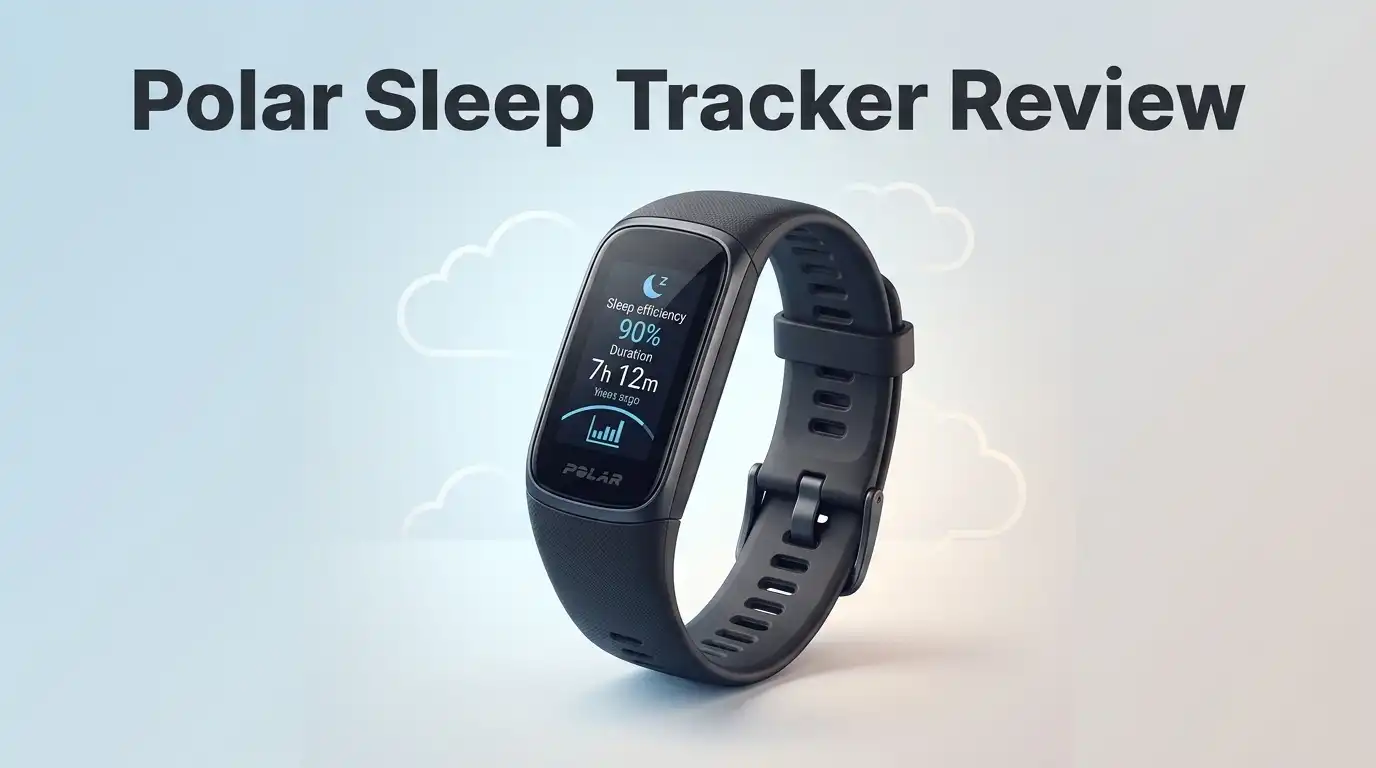
The Polar Loop launched in September 2025 at $199.99. It has no screen, no buttons, and no monthly fee. You wear it, and the Polar Flow app tells you the story each morning.
Inside sits a Precision Prime Optical Gen 3.5 heart rate sensor plus an accelerometer. That combination handles heart rate, heart rate variability, and movement. Those three inputs drive every sleep metric Polar produces.
The band weighs 29 grams total. That is light enough to vanish on your wrist within a day or two. Water resistance reaches 30 meters, so showers and pool sessions cause no worry.
The stainless steel case comes in Greige Sand, Night Black, and Brown Copper. Extra bands cost $29 each. The fabric strap threads through a metal buckle and closes with Velcro.
Polar aimed this squarely at Whoop. The resemblance is obvious and slightly awkward. It looks like gym equipment, not jewelry, and it clashes with anything dressier than a t shirt.
What makes it interesting for sleep specifically is the sensor quality. Polar has spent forty years refining heart rate measurement. That heritage shows up overnight, when small HRV shifts drive your recovery score.
Unboxing The Polar Loop: What Arrives In The Box
The box is small. Genuinely small. It feels closer to a phone case package than a fitness gadget.
Inside you find the sensor pod, two SoftWeave bands in small/medium and medium/large, one metal buckle, and a USB C charging cable. No wall brick. No printed manual worth reading.
The first surprise is that the band arrives unassembled. You thread the strap through the buckle yourself. Getting that buckle seated under the sensor took me a few frustrating minutes of wrestling.
Once it clicks into place, the fit becomes easy. You slide the sensor closer to or further from the buckle to adjust sizing. Polar includes a short video in the app that explains this better than any card in the box.
The setup video also shares a detail I would have missed. Wear it on your non dominant wrist, with the small oval on the underside pointing toward your thumb. That orientation improves sensor contact overnight.
You plug the pod in to wake it, open the Polar Flow app, and pair over Bluetooth. Firmware updates run during onboarding. The app then asks your preferred bedtime and sleep duration.
Total setup time was around ten minutes. Most of that was the buckle fight and the firmware download.
How Polar Tracks Sleep: Sleep Plus Stages Explained
Sleep Plus Stages is the engine behind every Polar sleep number. It starts automatically. You never press anything before bed.
The algorithm reads wrist movement and heart rate patterns together. From that it separates light sleep, deep sleep, and REM sleep. It also logs interruptions and time awake in bed.
You wake up to a sleep score between 1 and 100. That score combines six components grouped into three themes: amount, solidity, and regeneration.
Amount covers how long you slept against your personal need. Solidity measures continuity, meaning how badly interruptions chopped up your night. Regeneration weighs REM and deep sleep proportions.
The breakdown is more granular than most rivals offer. Polar shows actual sleep time, time in bed, sleep continuity on a scale of 1 to 5, and long interruptions counted separately from brief stirs.
Over a month of nights, the totals held up. Sleep start and wake times consistently landed within minutes of an Apple Watch Ultra 3 worn on the opposite wrist.
Stage data ebbed and flowed in similar patterns too. Stage boundaries never match exactly between brands, because no wrist device reads brain waves. Directionally, though, Polar agreed with everything else I tested.
Nightly Recharge: Your Morning Report Card
Nightly Recharge is Polar’s recovery metric, and it deserves attention. It splits recovery into two halves rather than one blended number.
ANS Charge measures your autonomic nervous system during the first four hours of sleep. It reads heart rate, heart rate variability, and breathing rate. This half reflects stress load, alcohol, illness, and hard training.
Sleep Charge reflects how your night compared with your own recent average. It uses that sleep score and your usual patterns as the baseline.
The combined status arrives as a simple label: very good, good, compromised, or poor. The two part structure is smarter than it looks. You can sleep nine hours and still see a compromised ANS Charge after a late meal or a hard interval session.
Polar needs roughly three nights before ANS Charge produces anything. It needs about a month before your personal baseline settles properly.
Alongside this sits Energy Boost, which estimates how much energy your sleep restored. Polar also charts HRV trends over weeks, which is the number I check most often.
One annoyance stands out. Energy Boost and Recharge each occupy separate cards on the diary page, while sleep stages live further down. The information is all there. The organisation makes you hunt.
Top 3 Alternative for Polar Loop

- EVERYTHING YOU NEED IS INCLUDED: Your WHOOP purchase includes a 12-month WHOOP One membership, a...
- CONTINUOUS MONITORING: WHOOP monitors your most important metrics, including sleep, heart rate...
Last update on 2026-08-18 / Affiliate links / Images from Amazon Product Advertising API Some of the links on this website are affiliate links, which means that at no additional cost to you, I earn a commission if you click through and make a purchase. I only recommend products and services that I believe will add value to my readers. Thank you for your support!
WHOOP 5.0 Activity Tracker

- ACCURACY - SMART SENSING - Oura tracks over 50 health metrics, including sleep, activity, stress...
- ACCURATE SIZING ESSENTIAL - Oura Ring 4 uses unique sizing different from standard jewelry rings...

Last update on 2026-08-21 / Affiliate links / Images from Amazon Product Advertising API Some of the links on this website are affiliate links, which means that at no additional cost to you, I earn a commission if you click through and make a purchase. I only recommend products and services that I believe will add value to my readers. Thank you for your support!
Oura Ring 4 Smart Ring

- Inspire 3 is the tracker that helps you find your energy, do what you love and feel your best. All...
- Move more: Daily Readiness Score(1), Active Zone Minutes, all-day activity tracking and 24/7 heart...
Last update on 2026-08-18 / Affiliate links / Images from Amazon Product Advertising API Some of the links on this website are affiliate links, which means that at no additional cost to you, I earn a commission if you click through and make a purchase. I only recommend products and services that I believe will add value to my readers. Thank you for your support!
Google Fitbit Inspire 3
SleepWise And Sleep Gate: Does The Advice Land?
SleepWise takes your last few weeks of sleep and predicts your alertness across the coming day. It produces an alertness score and a graph showing your likely high and low points.
The concept impresses on paper. Your circadian rhythm and your accumulated sleep debt both feed the model. Polar then plots when you will feel sharp and when you will fade.
In practice, the results are mixed. On nights of normal sleep, the curve matched how I felt. After genuinely bad nights, the prediction sometimes read worse than my actual day.
Sleep Gate is the more useful sibling. It suggests a bedtime window based on your recent patterns and your sleep debt. Hitting that window consistently improved my sleep score within a week.
Polar frames these as guidance, not diagnosis. The basic app offers short takeaways such as prioritise a regular rhythm. Deeper coaching sits behind the Polar Fitness Program at $8.99 per month after a 30 day trial.
Here is my honest read. SleepWise is a thoughtful feature that needs more nights than most people will give it. If you sleep on an irregular schedule, shift work included, the predictions wobble.
The value of Sleep Gate is real though. A repeatable bedtime fixes more sleep problems than any score ever will.
Polar Vantage M3: The Watch Route To Polar Sleep Data

- [AMOLED Display & Durability] Features a 1.28” AMOLED touchscreen with Gorilla Glass 3, ensuring...
- [Powerful Training & Sensing] Specialized to measure running power, training load, and recovery...
Last update on 2026-08-18 / Affiliate links / Images from Amazon Product Advertising API Some of the links on this website are affiliate links, which means that at no additional cost to you, I earn a commission if you click through and make a purchase. I only recommend products and services that I believe will add value to my readers. Thank you for your support!
If you want a screen, the Vantage M3 delivers identical sleep algorithms in watch form. Same Sleep Plus Stages. Same Nightly Recharge. Same SleepWise.
The watch adds a 1.28 inch AMOLED display with Gorilla Glass 3, dual frequency GPS, turn by turn navigation, and roughly seven days of battery in smartwatch mode.
The trade is comfort versus capability. A watch case presses into your wrist when you sleep on your side. The Loop band sits flatter and disappears more easily.
The M3 wins on everything else. It maps runs without your phone. It shows your sleep summary on your wrist at 6am. It tracks specific sport profiles properly.
For sleep purists, the watch also lets you review data on the Polar Flow web dashboard with more screen space. That dashboard remains one of Polar’s underrated strengths.
Battery life drops if you run GPS often. A daily runner charges roughly twice a week, which means choosing when to skip a night of tracking.
Pick the M3 if you train seriously and want one device for everything. Pick the Loop if sleep and recovery are the priority and you already own a running watch.
Accuracy: How Close Does Polar Get To A Sleep Lab?
Polar validated Sleep Plus Stages against polysomnography. That is the clinical standard involving brain wave sensors in a lab. Very few consumer brands publish that comparison.
An important caveat comes straight from Polar. The algorithm was developed and validated in healthy adults with normal sleep patterns. It is not built to flag sleep disorders.
If you suspect sleep apnea, no Polar device will tell you. There is no SpO2 sensor to detect oxygen dips. Talk to a doctor instead of buying a band.
In my testing, total sleep duration proved the most reliable number. Night after night it matched the Apple Watch within roughly ten minutes.
Heart rate accuracy overnight was excellent, which makes sense given the sensor pedigree. Resting heart rate and HRV readings stayed stable and believable.
Stage percentages showed the usual consumer variance. Polar tended to credit slightly more deep sleep than Whoop on identical nights. Neither is provably right.
Independent research on wrist worn devices reaches a consistent conclusion. Sleep and wake detection is strong. Stage classification is approximate everywhere.
Treat the trend line as the truth and the nightly stage split as an estimate. That is the correct way to read any sleep tracker in 2026.
Battery Life And Charging Reality
Eight days. Polar claims it and Polar delivers it. That figure held up across repeated cycles with the Loop.
Charging runs over USB C and takes well under two hours. You plug in during an afternoon at home and never miss a night of data.
Context makes this number look better. The Fitbit Charge 6 manages around three days with its display on. Screens drain batteries, and the Loop has none.
Context also makes it look worse. Whoop 5.0 runs roughly two weeks and ships with a battery pack that clips on while you wear it. You never remove Whoop at all.
The Loop has no such pack. Missing one night of data every eight days is the cost of a cheaper device.
Polar does confirm the battery is replaceable, which matters over a three year ownership window. Sealed batteries turn wearables into landfill.
One practical tip. Charge the Loop in the morning, not at night. You lose step data instead of sleep data, and sleep data is the reason you bought it.
Comfort Overnight: Do You Forget You Are Wearing It?
Comfort decides whether a sleep tracker gets used. A band you remove at 2am tracks nothing.
The Loop scores well here. The SoftWeave fabric breathes, dries fast after workouts, and never irritated my skin. Older Whoop bands caused rashes for many users. This did not.
The Velcro closure is the compromise. You often rethread the strap through the buckle when putting it on. It takes seconds, yet it is more fiddly than a clasp.
The sensor pod measures around 42 by 27 by 9 millimetres. That is slightly larger than a Whoop pod. Side sleepers may notice it against a pillow occasionally.
A smart ring beats both for pure sleep comfort. The Oura Ring 4 disappears entirely on your finger. Rings, though, struggle during weight training and cannot read heart rate as reliably during hard exercise.
Fit matters more than people expect. Too loose and the optical sensor loses contact, producing gaps in HRV data. Too tight and you wake with a mark on your wrist.
Snug, not tight, one finger width above the wrist bone. That positioning fixed the small data gaps I saw during my first week.
Pros And Cons Of Polar Sleep Tracking
Here is the balanced summary after weeks of nightly use.
Pros
- No subscription on the Loop. Every sleep feature is included in the $199.99 purchase price, which saves hundreds compared with Whoop over a few years.
- Sleep Plus Stages is validated against polysomnography, giving Polar stronger scientific footing than most consumer brands can claim.
- Nightly Recharge splits recovery into ANS Charge and Sleep Charge, which explains why you feel tired rather than just telling you that you are.
- Eight days of real battery life removes charging anxiety and keeps your data continuous.
- Overnight heart rate and HRV accuracy is excellent, thanks to the Precision Prime sensor and forty years of Polar heart rate work.
- Cardio Load uses TRIMP, an established training load system that accumulates properly instead of capping at an arbitrary ceiling.
Cons
- No SpO2 sensor. Blood oxygen tracking is absent, so breathing disturbances go undetected.
- Skin temperature sensing is inactive on the Loop and reserved for developers.
- Automatic workout detection misfires often, missing sessions or ending them early, and sessions cannot be edited afterward.
- Polar Flow feels cluttered. Sleep data spreads across several cards, forcing extra taps to see the full picture.
- No alarm function on the Loop, so your phone still wakes you up.
- The design looks industrial and pairs poorly with anything other than gym clothes.
What Polar Sleep Tracking Does Not Do Well
Authentic reviews name the failures, so let me be direct about the gaps.
Polar does not do health screening. There is no ECG, no SpO2, no atrial fibrillation alert, no active temperature trend. Fitbit and Apple offer more here for less money.
Polar does not do prescriptive coaching well without paying extra. The free app tells you what happened. Whoop tells you what to do about it, in plainer language, with better visuals.
The app organisation genuinely holds the product back. Excellent data hidden behind poor navigation feels worse than mediocre data presented clearly.
Automatic exercise detection is the biggest functional letdown. During interval sessions the Loop sometimes decided a rest break meant the workout ended. Training load then reads artificially low, which quietly corrupts recovery advice.
Polar also lacks the smart features many buyers expect. No notifications on the Loop. No music control. No contactless payments. It is a sensor, not a smartwatch.
One more honest note. Polar Flow’s revamp has been rolling out in phases, and the experience differs between iOS and Android depending on your update status.
If you want polish above all else, look elsewhere. If you want trustworthy physiological data without a subscription, Polar earns its place.
Polar Versus Whoop Versus Oura For Sleep
These three dominate the conversation, so here is how they separate.
Whoop 5.0 costs $239 per year minimum. It runs 16 days per charge, includes SpO2 and skin temperature, and presents sleep coaching beautifully. It detects workouts almost perfectly.
Oura Ring 4 costs around $349 upfront plus roughly $5.99 monthly. It offers the best sleep comfort available and strong temperature trend tracking for illness and cycle insights.
Polar Loop costs $199.99 once. It matches both on core sleep timing accuracy and beats both on training load logic. It loses on extra sensors and app polish.
The subscription question decides most purchases. Three years of Whoop costs over $700. Three years of the Loop costs $199.99.
For pure sleep insight, Oura leads on comfort and Whoop leads on presentation. For runners and cyclists who also want sleep data, Polar’s recovery model connects better to actual training.
A simple filter helps. Choose Oura if sleep is your only goal. Choose Whoop if you want a coach and accept the fee. Choose Polar if you value ownership and heart rate accuracy.
Who Should Buy A Polar Sleep Tracker In 2026?
The Polar Loop suits people who already train and want overnight recovery context. Runners, cyclists, and gym regulars fit this profile.
It suits people who hate subscriptions. That group is larger than the wearable industry admits.
It suits existing Polar owners perfectly. If you run with a Vantage or Grit X, the Loop extends the same ecosystem across your nights without duplicating your watch.
It does not suit people wanting health screening. Anyone worried about breathing during sleep needs SpO2 at minimum, and realistically needs a clinical evaluation.
It does not suit people who want notifications on their wrist. Buy the Vantage M3 or Ignite 3 instead.
It does not suit style conscious buyers. The Loop looks like equipment, and that will bother some people every single day.
Price and value verdict: at $199.99 with no fees, eight day battery, and clinically validated sleep staging, the Polar Loop offers the strongest value in the screenless tracker category right now. It is not the most polished option. It is the most honest one for the money.
Frequently Asked Questions
Is Polar sleep tracking accurate?
Yes for sleep duration and timing. Polar validated Sleep Plus Stages against polysomnography in healthy adults. Stage percentages remain estimates, as with every wrist device.
Does the Polar Loop need a subscription?
No. All core sleep, recovery, and activity features are included in the purchase price. Only the optional Polar Fitness Program costs $8.99 monthly.
Can Polar detect sleep apnea?
No. There is no SpO2 sensor, and Polar states clearly that its algorithm cannot identify sleep problems. See a doctor if you suspect a disorder.
How long does the Polar Loop battery last?
Around eight days of normal use, confirmed in testing. Charging happens over USB C in under two hours.
Do I need to start sleep tracking manually?
No. Polar detects sleep automatically once you set a preferred bedtime and duration during setup.
How many nights before the data is useful?
ANS Charge needs about three nights. Full baselines for Nightly Recharge and SleepWise need roughly 28 nights.
Which Polar device is best for sleep?
The Loop for comfort and battery. The Vantage M3 if you want the same sleep features plus GPS and a screen.

Hi, I’m Elowen Porter, the creator of GreenLight.blog.
I share honest reviews and insights on supplements and Amazon health products to help you make smarter wellness choices.
With a passion for natural living and evidence-based products, I dig deep to find what truly works.
My goal is to simplify your supplement search with real results and trusted recommendations.
Let’s make healthy living a little easier—one product at a time.